A Departure from Migratory Tradition
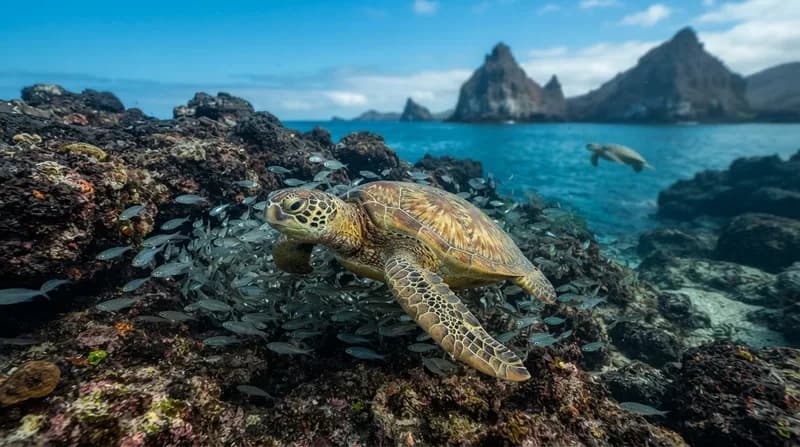
Sea turtles have long been viewed as the grand voyagers of the marine world. Equipped with an innate ability to navigate via magnetic fields, solar cues, and ocean currents, these creatures typically traverse thousands of miles to reach ancestral feeding and breeding grounds. However, a groundbreaking three-year study published in Frontiers in Amphibian and Reptile Science has challenged this narrative, focusing on a specific population of "yellow-morph" green sea turtles (Chelonia mydas) residing within the Galápagos Marine Reserve.
Contrary to scientific expectations that these turtles would embark on massive trans-Pacific migrations, the research team discovered that these animals are surprisingly stationary. By utilizing satellite transmitters to monitor the movements of nine adult turtles, researchers found that none of the tagged subjects left the boundaries of the Galápagos Marine Reserve throughout the duration of the study. This revelation highlights a significant departure from the behavior typically associated with their species.
Understanding the Genetic Morphs
The Galápagos Islands serve as a unique ecological crossroads where two genetically distinct forms of green sea turtles coexist: the yellow-morph and the black-morph. While both types occupy the same waters and share a diet consisting primarily of seagrasses and algae, they exhibit subtle but distinct physiological differences. Notably, young yellow-morph turtles demonstrate faster growth rates compared to their black-morph counterparts, suggesting distinct evolutionary adaptations that remain a subject of intense scientific interest.
The study sought to map how these yellow-morph individuals utilize the 198,000 square kilometer marine reserve. By tracking the turtles for up to 418 days, the team revealed a strong affinity for shallow coastal habitats. While some individuals occasionally ventured up to 25 kilometers from shore, the vast majority of their time was spent tethered to the island archipelagos. This behavior suggests that the Galápagos environment offers such an ideal habitat that the need for long-distance migration is significantly reduced, or perhaps entirely absent, for this specific demographic.
Movement Patterns and Seasonal Shifts
The movement data uncovered a fascinating pattern of "island hopping." Rather than staying confined to a single beach, many of the tracked turtles, such as those nicknamed Bernardo, Sara, and Leandro, regularly traversed the waters between multiple islands. This localized travel was not entirely random; the researchers observed a clear seasonal trend, with inter-island movement occurring primarily during the cooler months between April and October.
The scale of these territories was also quite significant, with individual home ranges averaging roughly 1,498 square kilometers. Despite this range, the turtles showed a remarkable reluctance to exit the reserve entirely. The study authors, including Dr. John W. Rowe and Dr. Juan Pablo Muñoz-Pérez, suggest that this behavior necessitates a shift in conservation strategy. Because these turtles rely on a network of habitats across multiple islands, protecting isolated coastal zones is insufficient. Instead, policy must focus on maintaining the integrity of the entire archipelago’s coastal waters and the migratory corridors that connect them to ensure the continued survival of these homebound marine giants.