ScienceTechnical Deep Dive

Hera Mission Unveils Mysterious Surface of Asteroid Didymos

Published
EElectricBuzz Editorial Team
Hera Mission Unveils Mysterious Surface of Asteroid Didymos
3 min read456 wordsElectricBuzz Editorial Team

The Gist

“ESA’s Hera spacecraft has reached the Didymos system, providing the first detailed, close-up look at the site of NASA's historic planetary defense experiment.”

A New Perspective on a Known Target

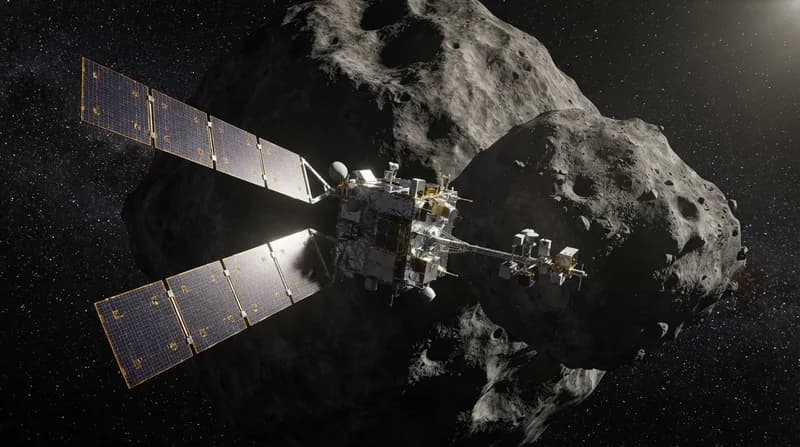
The European Space Agency’s (ESA) Hera mission has officially arrived at the Didymos binary asteroid system, marking a significant milestone in our quest to understand planetary defense. After a two-year journey spanning nearly 200 million kilometers, the spacecraft has captured its initial close-up images of the larger asteroid, Didymos. Using its high-resolution monochromatic Asteroid Framing Camera, Hera has provided scientists with a perspective previously unseen, revealing complex geological features that were obscured during the initial 2022 NASA DART collision mission.

The images display a terrain defined by a distinct equatorial ridge, punctuated by an array of boulders, craters, and mysterious surface grooves. This "new" side of Didymos has surprised researchers, prompting immediate scientific debate regarding the asteroid's formation and the lasting effects of the kinetic impact that occurred on its smaller companion, Dimorphos.

Investigating the Aftermath of DART

The core objective of the Hera mission is to conduct a forensic analysis of the DART (Double Asteroid Redirection Test) impact. In September 2022, NASA successfully struck the 151-meter Dimorphos with a 580-kg spacecraft traveling at roughly 6.1 km/s. This dramatic event successfully altered the orbit of the moonlet by approximately 33 minutes, far exceeding initial scientific projections and proving that humans possess the capability to redirect a hazardous space object.

Hera is now tasked with determining the physical aftermath of this collision. One of the primary hypotheses currently being tested is the transfer of ejecta. Scientists believe that the massive force of the DART impact sent debris hurtling across the 1-km gap between the two asteroids. Some of these materials likely settled on the surface of Didymos, potentially contributing to the unique geological patterns, such as the ridges and grooves, that Hera has just begun to document.

Why it matters: The Future of Planetary Defense

The transition from a one-time experiment to a reliable defense system requires a deep understanding of impact physics. By mapping the Didymos-Dimorphos system in extreme detail, Hera aims to provide the data necessary to refine predictive models for future deflection missions. This knowledge is crucial for developing a standardized technique that could safeguard Earth from future near-Earth object threats.

  • Kinetic Impact Validation: Hera will turn a successful demonstration into a repeatable engineering practice.
  • Systemic Mapping: The mission will document surface changes on both asteroids to understand how impacts alter binary systems.
  • Predictive Accuracy: Data collected will improve future calculations for mass, density, and structural integrity of asteroids.

As the mission progresses, researchers look forward to November 25, when a suite of more detailed images of both bodies will be released. This data will be instrumental in finalizing the assessment of how humanity can best protect the planet from the unexpected dangers of the solar system.


SPONSORED
The 5 Best Over-Ear ANC Headphones of 2026, Tested & Ranked
Editor's Pick Guide
92/100
Tech & Gadgets•12 min read

The 5 Best Over-Ear ANC Headphones of 2026, Tested & Ranked

We locked five over-ear ANC picks for 2026 — Sony WH-1000XM6, Bose QuietComfort Ultra 2, Soundcore Space One, Sennheiser Momentum 5, and Apple AirPods Max 2 — then stress-tested them on lab metrics, long-term owner truth, and live street prices.

Related Stories

Semantically matched articles, ranked by topic overlap and freshness.

Stellar Collision Course: The Hidden Engines Feeding Sagittarius A*
Science

Stellar Collision Course: The Hidden Engines Feeding Sagittarius A*

Astronomers have uncovered a cosmic food chain in the heart of our galaxy, linking a powerful binary star system to the steady fuel supply of the Milky Way's supermassive black hole.

Mapping the Genetic Blueprint of Immune Aging
Science

Mapping the Genetic Blueprint of Immune Aging

Researchers at Monash University have mapped the genetic mechanisms behind immune system decline, offering new hope for targeted cancer and infection therapies.

Ketogenic Diet Outperforms Other Methods in Rapid Liver Fat Reduction
Science

Ketogenic Diet Outperforms Other Methods in Rapid Liver Fat Reduction

A new clinical trial reveals that a ketogenic diet significantly outperforms Mediterranean and low-fat protocols in reducing liver fat and reversing prediabetes, independent of total weight loss.

New Glass Scintillator Breakthrough Promises Low-Cost Radiation Detection
Science

New Glass Scintillator Breakthrough Promises Low-Cost Radiation Detection

Researchers have developed a versatile, cost-effective cerium-doped gadolinium glass capable of detecting various forms of radiation, potentially revolutionizing medical imaging and high-energy physics.

Nature’s Most Asymmetrical Masterpiece: The 6-Million-Year-Old Whale That Defied Evolution
Science

Nature’s Most Asymmetrical Masterpiece: The 6-Million-Year-Old Whale That Defied Evolution

Paleontologists have uncovered a prehistoric pygmy sperm whale with a face so profoundly crooked it challenges everything we know about mammalian anatomy.

AI Breakthrough Turns Implantable Defibrillators into Early Warning Systems
Science

AI Breakthrough Turns Implantable Defibrillators into Early Warning Systems

Researchers have developed an AI-powered model that analyzes subtle electrical signals from heart implants to predict life-threatening arrhythmias months in advance.

Lubdub Moves Wearable ECG Technology from Research Lab to Clinical Trial
Science

Lubdub Moves Wearable ECG Technology from Research Lab to Clinical Trial

A new gel-free, waterproof wearable patch developed by RMIT University spin-off Lubdub aims to streamline cardiac monitoring and bridge the gap between early symptoms and professional diagnosis.

New Metabolic Compound Boosts Fat Burning While Preserving Muscle Mass
Science

New Metabolic Compound Boosts Fat Burning While Preserving Muscle Mass

Researchers at UC Berkeley have discovered a breakthrough compound that increases energy expenditure without the muscle loss often associated with current weight-loss drugs.