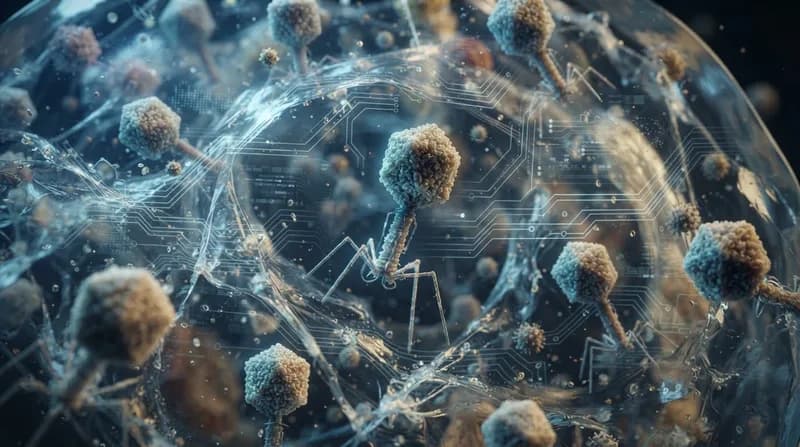
The Rise of AI-Engineered Phages
In a groundbreaking shift for modern medicine, the biotechnology company Radical Numerics has reported the first successful deployment of AI-designed viruses to treat a patient suffering from an antibiotic-resistant bacterial infection. By leveraging a specialized AI model known as Omnii, researchers were able to engineer bacteriophages—viruses that naturally prey on bacteria—to target specific, resilient pathogens that traditional antibiotics could no longer manage. This collaborative effort with Tabula Bioscience represents a departure from traditional drug development, moving toward a precision medicine approach where biological tools are programmed to solve clinical challenges.
The global rise of antibiotic resistance, which the CDC warns could lead to tens of millions of fatalities by 2050, has forced scientists to look beyond standard drug therapies. Bacteriophage therapy has long been recognized as a potential solution, but the difficulty of identifying and modifying the right virus for a specific patient has historically limited its clinical utility. The introduction of AI to this process streamlines the identification of optimal genetic modifications, allowing researchers to tweak the protein-based 'legs' of a phage to ensure it can anchor itself to and neutralize the target bacteria effectively.
How AI Powers Biological Design
The core of this innovation lies in the AI model's ability to decode and manipulate complex genomic data. By training on vast sets of nucleotide sequences, the Omnii model learns the inherent patterns of viral and bacterial DNA. When a scientist identifies a problematic infection, the AI can be used to predict which specific genetic alterations will enable a virus to bypass a pathogen's cellular defenses and gain entry to deliver its payload.
Think of the process as a biological 'prompt' system. A researcher inputs the target bacterial strain, and the model proposes a series of candidate viral modifications. While not every suggestion is viable, the ability to rapidly simulate these outcomes in a virtual space drastically reduces the time and resources required to find a potent, host-specific treatment. This digital-to-biological pipeline provides a rapid response mechanism that can be adapted to evolving strains that would otherwise render conventional, mass-produced antibiotics obsolete.
Why It Matters
- Precision Treatment: AI-designed phages can specifically target harmful bacteria, potentially sparing the patient's beneficial microbiome—a common casualty of broad-spectrum antibiotics.
- Customization: Each phage can be tuned to the specific needs of an individual patient, enabling personalized infectious disease management.
- Global Impact: Beyond individual patient cases, this technology offers a scalable method for addressing widespread public health crises like cholera, where tailored interventions could stop outbreaks at their source.
Navigating Future Challenges
Despite the excitement, experts remain cautious about the implications of synthetic biological design. The rapid evolution of viruses means that even an AI-designed organism could mutate in unpredictable ways once inside a human host. Furthermore, the regulatory path forward remains unwritten. Because these treatments are highly specific, traditional FDA approval processes—designed for mass-market drugs—may require significant adaptation to accommodate case-by-case, AI-enabled therapies.
Ultimately, the consensus among researchers is that AI should serve as a high-tech partner to human expertise rather than a replacement. The integration of rigorous laboratory testing, biological safety oversight, and iterative design is essential to ensure that while we embrace these new tools to fight superbugs, we do not inadvertently introduce new risks. If successfully matured, AI-designed viruses could become the new gold standard in infectious disease control, effectively turning the tables in the ongoing war against microbial evolution.