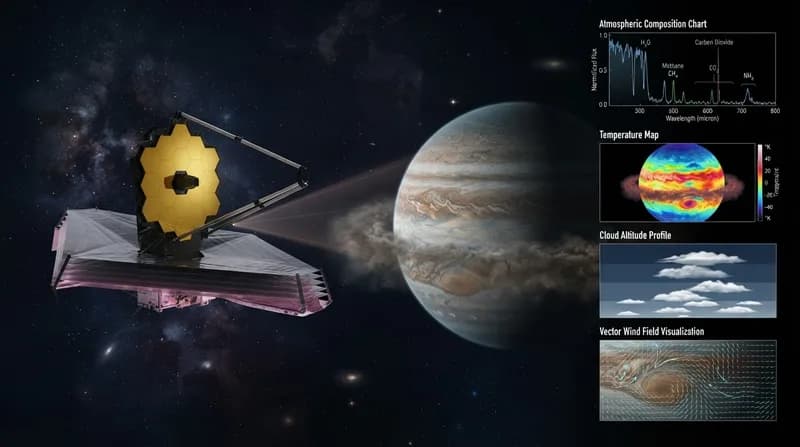
Decoding the Atmosphere of SIMP 0136
In a major leap for planetary science, researchers from Trinity College Dublin have utilized data from NASA's James Webb Space Telescope (JWST) to peer into the turbulent atmosphere of SIMP 0136. Located 20 light-years from Earth, this object is a brown dwarf—a celestial body that straddles the line between a gas giant planet and a star. While brown dwarfs lack the necessary mass to ignite as stars, they host massive, rapidly evolving weather systems that make them extreme laboratories for atmospheric physics.
By applying a sophisticated mathematical framework known as Principal Component Analysis (PCA), the team successfully filtered out the noise inherent in deep-space observations. Rather than imposing theoretical models onto the data, the researchers allowed the telescope's high-precision brightness measurements to dictate the findings. The result was a clear, revealing look at how temperature shifts and vertical cloud arrangements dictate the environment of this distant, mysterious world.
The Anatomy of Alien Weather
The most striking finding from the study is the existence of an underlying structure within what previously appeared to be chaotic weather. The team identified three recurring states that shift and rotate as the brown dwarf spins, creating an atmospheric patchwork. Some zones are characterized by heat and thin cloud cover, while others feature cooler temperatures and dense, vertically extended cloud systems.
These patterns are not random; they are governed by persistent, stable drivers that continue to dictate atmospheric behavior over extended periods. Even as the visual appearance of the brown dwarf evolves across dozens of rotations, the fundamental "weather report" remains consistent. This discovery transforms our understanding of these objects, suggesting that even the most extreme alien environments are guided by predictable, measurable physical laws.
Why It Matters
- New Methodology: The use of PCA allows astronomers to rapidly analyze complex, high-dimensional datasets from JWST, setting a new standard for how we interpret light signatures from distant objects.
- Bridge to Exoplanets: Because brown dwarfs are often easier to observe directly than planets orbiting distant stars, they serve as essential proxies for understanding the atmospheres of giant exoplanets.
- Probing Habitability: By refining our ability to model heat distribution, cloud formation, and atmospheric circulation, this research provides the tools necessary to evaluate whether distant worlds might host conditions suitable for life.
Implications for Future Space Exploration
This breakthrough is more than just a map of one specific brown dwarf; it is a scalable blueprint for future research. As astronomers continue to point the JWST at a wide array of celestial objects, the ability to quickly distill complex light variability into dominant components will save massive amounts of computational time. This efficiency will allow researchers to prioritize which targets require deeper, resource-heavy modeling.
For the research team, this study also serves as a poignant reminder of the scale of space. The light captured by the telescope for this study left its origin point two decades ago—coinciding with the birth of the lead author. Mapping the intricate weather of a world so far away, based on a single point of light captured through an array of sensitive lenses, underscores the rapid evolution of our capability to understand the universe from our vantage point on Earth.