The Classical Paradox of Black Hole Stability
In the traditional framework of general relativity, black holes are famously stubborn. According to the late Stephen Hawking’s area theorem, a stationary black hole—the Schwarzschild variety—possesses a level of structural integrity that precludes it from simply splitting apart. Hawking argued that such a division would violate the second law of thermodynamics by decreasing the total entropy of the system, making spontaneous fission a physical impossibility under standard classical conditions.
For decades, this consensus has remained a pillar of gravitational physics, supported by observations of black hole mergers. However, a collaborative team of researchers from Italy, Denmark, and France is now questioning whether this rigidity holds up under extreme conditions. Their research, published in Physical Review D, introduces the provocative concept of 'pants'—a visual analogy for a single black hole event horizon branching into two distinct legs.
The Role of Extreme Rotation
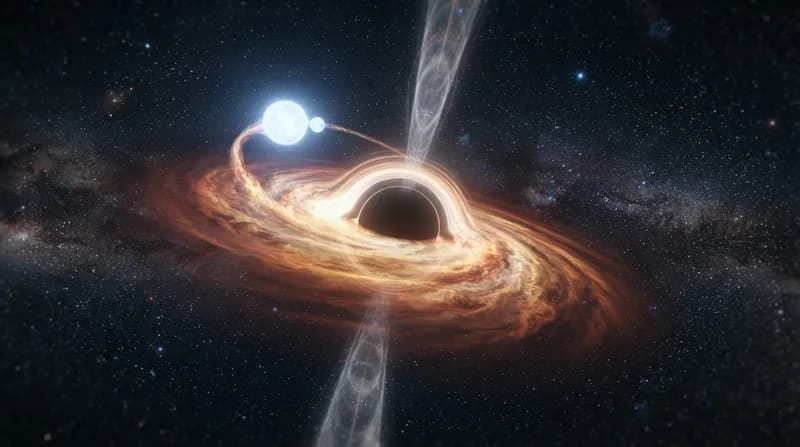
The research team, led by Francesco Sannino of the University of Naples Federico II, posits that the secret to this potential fission lies in rotational energy. Unlike stationary black holes, those spinning near their theoretical maximum rate harbor a massive reservoir of angular momentum. This energy, the team theorizes, could theoretically be converted into the orbital motion required to separate the two resulting fragments.
However, the hurdles are significant. For a black hole to split, it must satisfy three rigorous conditions: it cannot decrease the system’s total entropy, it must conserve energy and angular momentum, and the resulting pieces must possess sufficient kinetic energy to overcome their own mutual gravitational pull. Sannino emphasizes that while this 'pants-wearing' scenario is mathematically possible, it would likely only occur in a narrow regime of extreme, near-limit spin, where gravity is pushed to its absolute edge.
Beyond Einstein: Alternative Dimensions and Instabilities
The study also ventures into theories beyond classical general relativity, exploring how modifications to gravity or the introduction of additional spatial dimensions could alter the rules of the game. In these higher-dimensional models, researchers identified scenarios where the creation of smaller black hole 'morsels' could actually lead to an increase in total entropy, thereby bypassing the classical prohibition on splitting.
Furthermore, the team pointed to the Gregory–Laflamme instability in higher-dimensional black strings and the inhomogeneous configurations of ultra-spinning Myers–Perry black holes as potential candidates for this phenomenon. These exotic objects, characterized by event horizons that can pinch off at their endpoints, offer a glimpse into a universe where black hole fission could be a feature of primordial cosmic evolution, particularly among the smaller black holes formed in the early stages of the universe.
Why it Matters
- Fundamental Gravity: These models help researchers stress-test Einstein’s general relativity against alternative gravitational theories.
- Early Universe Insight: Understanding if primordial black holes split provides clues about the high-energy environments of the infant cosmos.
- Entropy Limits: The study pushes the boundaries of thermodynamics in extreme curved spacetime.