ScienceTechnical Deep Dive

The Biohybrid Revolution: Implantable Devices Powered by Your Own Biology

Published
EElectricBuzz Editorial Team
The Biohybrid Revolution: Implantable Devices Powered by Your Own Biology
3 min read461 wordsElectricBuzz Editorial Team

The Gist

“Engineers have unveiled a groundbreaking mesh device that harvests energy from human tissue, potentially eliminating the need for surgical battery replacements in pacemakers.”

A Paradigm Shift in Bio-Electronics

For decades, the life cycle of implantable medical devices like pacemakers and cardioverter-defibrillators has been dictated by the longevity of their onboard batteries. While these power units can last up to 15 years, their inevitable depletion necessitates high-risk, invasive surgical procedures to replace the hardware. Now, a team of researchers at the University of Massachusetts Amherst has introduced a radical alternative: a biohybrid mesh harvester that operates not as a static battery, but as an integrated component of human tissue itself.

Led by principal investigator Jun Yao and lead author Siqi Wang, the team drew inspiration from the natural power-generating capacity of individual human cells. By shifting away from a centralized battery model toward a distributed, tissue-integrated energy network, they have created a system that mimics the movement and flexibility of biological structures while generating consistent electrical power.

The Technology Behind the Mesh

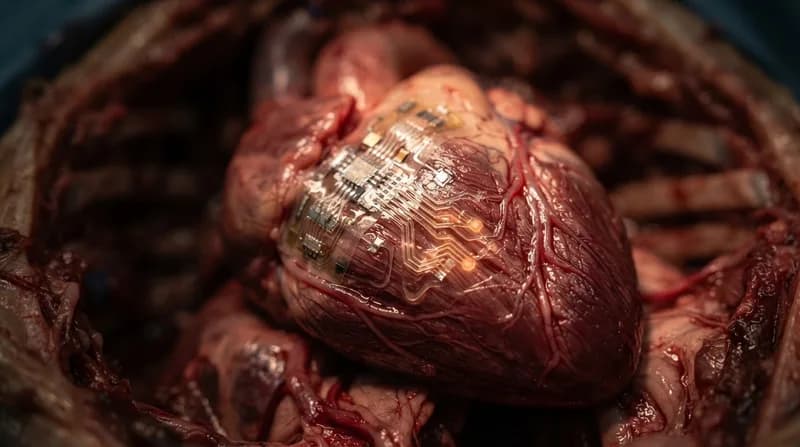
The device is constructed from an array of ultrathin ribbons arranged on an ultraflexible polymer platform. To achieve seamless integration, the researchers engineered the ribbons with lateral dimensions between 20 and 100 micrometers—smaller than a typical human cell—which encourages biological cells to attach and thrive around the mesh. The lattice-like structure creates a rectangular grid with sufficient spacing to allow cellular infiltration, effectively merging the synthetic hardware with natural tissue.

At the core of the harvesting mechanism is a thin film of lead zirconate titanate (PZT). This material, known for its piezoelectric properties, is sandwiched between electrodes to convert the mechanical energy of contracting tissue into electrical energy. The entire assembly is insulated with biocompatible polyimide and SU-8 photoresist, ensuring the device remains durable and non-toxic within the body's internal environment.

Technical Specifications and Performance

  • Harvesting Mechanism: Piezoelectric transduction via lead zirconate titanate (PZT) thin films.
  • Structural Design: Rectangular lattice of thin-film ribbons on a flexible polyimide and SU-8 polymer substrate.
  • Cell Compatibility: Designed for integration with human cardiac cells (cardiomyocytes).
  • Power Density: Achieves a ten-fold increase in power density compared to conventional centralized harvesting systems.
  • Scalability: Modular design allows for layering multiple mesh sheets to boost total energy output as needed.

Why It Matters

The implications of this technology reach far beyond simple convenience. By harvesting energy directly from the body's natural physiological processes—such as muscle contractions or cardiac beats—this mesh harvester offers a perpetual power supply that could theoretically last for the lifetime of the implant. This eliminates the medical trauma, infection risks, and financial burdens associated with repeated surgical battery replacements.

Furthermore, the ability of these devices to seamlessly integrate with cardiac microtissues suggests future applications in regenerative medicine. As the research progresses, the team anticipates that this biohybrid architecture could be adapted to harness various forms of energy, potentially revolutionizing the field of long-term patient monitoring and implantable diagnostics.


SPONSORED
The 5 Best Over-Ear ANC Headphones of 2026, Tested & Ranked
Editor's Pick Guide
92/100
Tech & Gadgets•12 min read

The 5 Best Over-Ear ANC Headphones of 2026, Tested & Ranked

We locked five over-ear ANC picks for 2026 — Sony WH-1000XM6, Bose QuietComfort Ultra 2, Soundcore Space One, Sennheiser Momentum 5, and Apple AirPods Max 2 — then stress-tested them on lab metrics, long-term owner truth, and live street prices.

Related Stories

Semantically matched articles, ranked by topic overlap and freshness.

Stellar Collision Course: The Hidden Engines Feeding Sagittarius A*
Science

Stellar Collision Course: The Hidden Engines Feeding Sagittarius A*

Astronomers have uncovered a cosmic food chain in the heart of our galaxy, linking a powerful binary star system to the steady fuel supply of the Milky Way's supermassive black hole.

Mapping the Genetic Blueprint of Immune Aging
Science

Mapping the Genetic Blueprint of Immune Aging

Researchers at Monash University have mapped the genetic mechanisms behind immune system decline, offering new hope for targeted cancer and infection therapies.

Ketogenic Diet Outperforms Other Methods in Rapid Liver Fat Reduction
Science

Ketogenic Diet Outperforms Other Methods in Rapid Liver Fat Reduction

A new clinical trial reveals that a ketogenic diet significantly outperforms Mediterranean and low-fat protocols in reducing liver fat and reversing prediabetes, independent of total weight loss.

New Glass Scintillator Breakthrough Promises Low-Cost Radiation Detection
Science

New Glass Scintillator Breakthrough Promises Low-Cost Radiation Detection

Researchers have developed a versatile, cost-effective cerium-doped gadolinium glass capable of detecting various forms of radiation, potentially revolutionizing medical imaging and high-energy physics.

Nature’s Most Asymmetrical Masterpiece: The 6-Million-Year-Old Whale That Defied Evolution
Science

Nature’s Most Asymmetrical Masterpiece: The 6-Million-Year-Old Whale That Defied Evolution

Paleontologists have uncovered a prehistoric pygmy sperm whale with a face so profoundly crooked it challenges everything we know about mammalian anatomy.

AI Breakthrough Turns Implantable Defibrillators into Early Warning Systems
Science

AI Breakthrough Turns Implantable Defibrillators into Early Warning Systems

Researchers have developed an AI-powered model that analyzes subtle electrical signals from heart implants to predict life-threatening arrhythmias months in advance.

Lubdub Moves Wearable ECG Technology from Research Lab to Clinical Trial
Science

Lubdub Moves Wearable ECG Technology from Research Lab to Clinical Trial

A new gel-free, waterproof wearable patch developed by RMIT University spin-off Lubdub aims to streamline cardiac monitoring and bridge the gap between early symptoms and professional diagnosis.

New Metabolic Compound Boosts Fat Burning While Preserving Muscle Mass
Science

New Metabolic Compound Boosts Fat Burning While Preserving Muscle Mass

Researchers at UC Berkeley have discovered a breakthrough compound that increases energy expenditure without the muscle loss often associated with current weight-loss drugs.