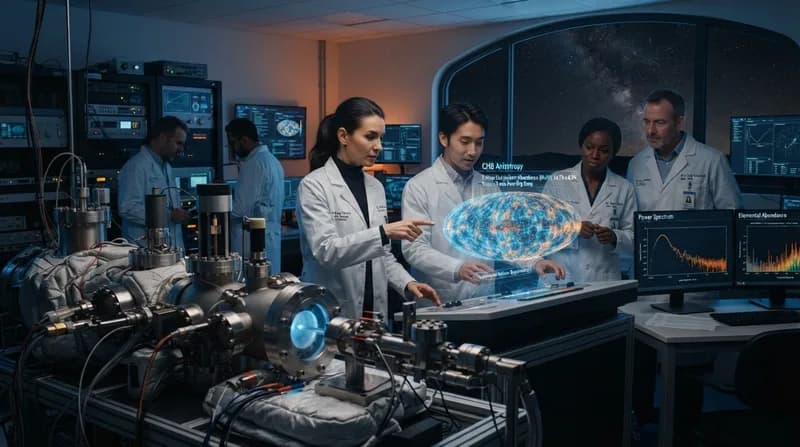
A New Standard of Precision
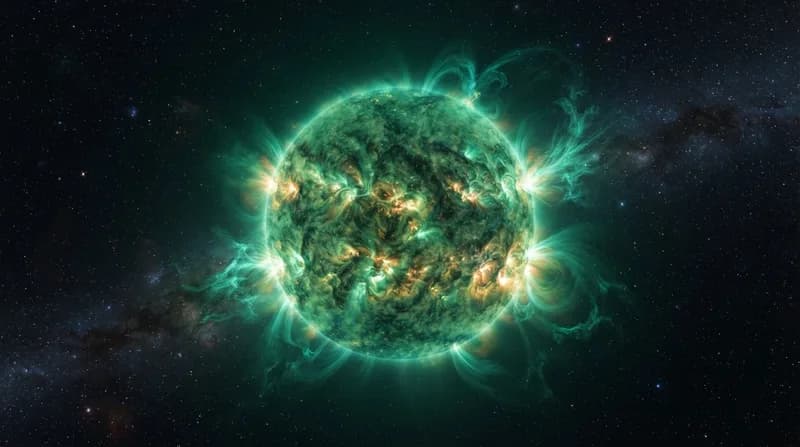
In a milestone for observational cosmology, an international team of researchers has mapped the chemical composition of the early Universe with unprecedented accuracy. By focusing on 15 remarkably pristine, distant galaxies, scientists have successfully measured the abundance of helium formed in the first five minutes following the Big Bang. This measurement, which reduces uncertainty to a mere 0.5%, is three times more precise than any previous attempt, providing a rigorous test for the Standard Model of physics.
The study, spanning 130 hours of observation using the Large Binocular Telescope (LBT), moves away from traditional extrapolation methods. Instead, the team treated these remote, chemically simple galaxies as cosmic time capsules. By analyzing these ancient structures, which have remained largely unaffected by the chemical enrichment typical of later stellar generations, the researchers gained a direct look at the primordial elements that defined the infant Universe.
Why Helium Matters
The abundance of primordial light elements—specifically helium and deuterium—serves as one of the three pillars supporting Big Bang theory, alongside cosmic expansion and cosmic microwave background radiation. While the latter two have been studied extensively, the precise ratio of helium has historically been difficult to pin down. Determining this value is critical because it acts as a diagnostic tool for the physical conditions present when the Universe was only minutes old.
Understanding these conditions allows scientists to calculate the number of neutrino families present during the early expansion. Since neutrinos are elusive, nearly massless particles, their influence on the early Universe provides essential data for testing whether our current physical theories accurately describe the fundamental laws of nature at their most extreme limits.
Why it matters
- Fundamental Physics: The measurement provides a strict test for the Standard Model, potentially exposing gaps in our understanding of elementary particles.
- Methodological Innovation: By utilizing specialized MODS spectrographs, the team simultaneously analyzed 10 helium and 15 hydrogen spectral lines, correcting for errors that previously hindered high-precision results.
- Cosmic Time Capsules: The selection of 15 pristine galaxies demonstrates a shift toward using specific, low-evolution celestial objects to isolate primordial signals from modern astronomical noise.
The Role of Advanced Instrumentation
Central to this breakthrough was the deployment of the Multi-Object Double Spectrograph (MODS) instruments. Developed over a 12-year period at Ohio State University, these instruments were specifically engineered to handle the delicate task of identifying subtle spectral signals from the distant Universe. The ability to simultaneously observe multiple helium and hydrogen lines was essential in accounting for the tiny measurement biases that could skew results at the sub-1% level.
This achievement serves as a testament to long-term collaborative investment in observational hardware. With the research published across five papers in The Astrophysical Journal, the team has effectively established a new benchmark for cosmological measurement, promising to fuel further debates and refinements in the field of astrophysics for years to come.