A New Frontier in Metrology
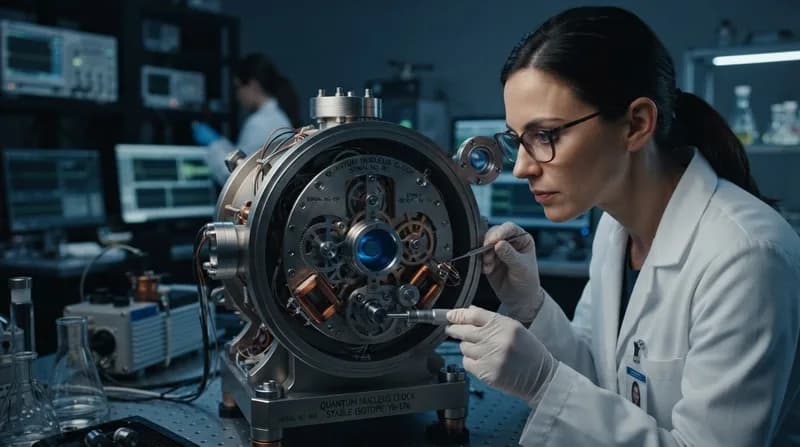
For decades, atomic clocks have served as the gold standard for timekeeping, relying on the predictable vibrations of electrons within atoms to define the passage of seconds. However, a research team at the Vienna University of Technology (TU Wien) has officially shifted the goalposts. In a recent development, scientists have successfully constructed the world’s first self-stabilizing nuclear clock, a device that taps into the inner stability of atomic nuclei rather than their orbiting electrons.
This achievement, detailed in a recent publication, marks a major milestone in metrology—the science of measurement. By moving the reference point for time from the fragile electronic shell of an atom to the hardened, compact nucleus, the team has created a prototype that is far less susceptible to environmental interference. While today’s best optical atomic clocks are feats of engineering, the nuclear clock offers a path toward a level of precision that was previously considered theoretical.
The Secret Potential of Thorium
The core of this innovation lies in the unique properties of thorium-229. Unlike most atomic nuclei, which require immense energy levels to transition between different states, thorium possesses an unusually small energy gap between its nuclear states. This quirk allows researchers to use laser light to precisely control and trigger these transitions.
This characteristic is the fundamental mechanism behind the device. In the prototype, a laser is directed at a specialized crystal embedded with thorium atoms. The system acts as a closed loop: the laser provides the frequency that drives the nucleus, and the nucleus, in turn, provides the stable rhythm. If external factors—such as temperature shifts—cause the laser frequency to drift, the thorium nucleus naturally absorbs less light. This drop in absorption acts as an immediate feedback signal, allowing the system to self-correct the laser frequency. This ability to maintain stability independently is what elevates this project from an experimental concept to a functioning, self-contained clock.
Accuracy at an Unprecedented Scale
The performance metrics of this early prototype are staggering. During testing, the nuclear clock demonstrated a relative precision equivalent to an error of approximately one second over 30 million years. This is achieved because atomic nuclei are roughly 10,000 times smaller than the atoms themselves, shielding them from the external magnetic and electric fields that often cause jitter in conventional atomic clocks.
Why It Matters
- Enhanced Fundamental Physics: Higher precision allows scientists to measure physical constants with greater accuracy, potentially uncovering new phenomena in the fabric of nature.
- Independence: Unlike previous nuclear prototypes that required linkage to an existing atomic clock for stabilization, this model functions autonomously.
- Future Scalability: The researchers note that this is merely a first-generation build. Future iterations utilizing higher-power lasers and refined thorium crystals are expected to surpass the accuracy of the world's current premier optical atomic clocks.
As the scientific community looks ahead, the implications of this breakthrough stretch far beyond just knowing the time. This technology could provide the foundation for next-generation GPS systems, improved deep-space navigation, and a more robust understanding of the gravitational and temporal anomalies of our universe. While we are years away from replacing the global infrastructure built around atomic time, the Vienna team has proven that the future of timekeeping will be nuclear.