The Discovery of a Cosmic Epilogue
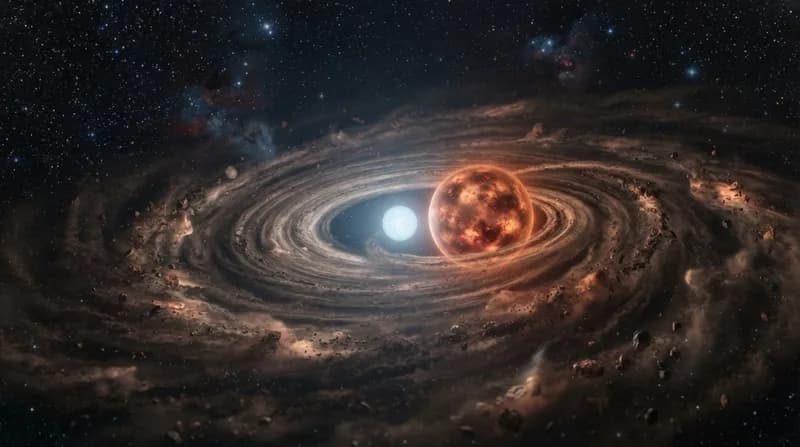
For decades, astronomers have viewed the white dwarf stage of stellar evolution as a final, quiet chapter—the cooling core of a star that has long since exhausted its fuel and cast off its outer layers into the abyss of space. However, a groundbreaking discovery using archival data from NASA’s Hubble Space Telescope suggests this "epilogue" might actually be a prologue for a new generation of worlds. Researchers have identified a chemical signature around the white dwarf HS 0209+0832 that points to the existence of a planet formed from the debris of its predecessor's death throes.
Led by Jamie Williams, a researcher at the University of Warwick, the team revisited Hubble observations dating back to 1999. While the data had long contained mysterious chemical signals that defied identification, modern database advancements allowed the team to pinpoint a high abundance of niobium. This heavy element does not form through standard thermonuclear fusion but is instead forged in the violent, exotic conditions of a dying star. Its presence suggests that the material surrounding this white dwarf is not just cosmic dust, but the recycled remains of a former star that have coalesced into a second-generation planet.
Evidence From Multiple Observatories
The strength of this discovery lies in its corroboration across different satellite missions. Beyond the spectral data provided by Hubble, the team cross-referenced their findings with the retired FUSE (Far Ultraviolet Spectroscopic Explorer) mission, which confirmed the presence of the unique niobium signature. These independent observations reinforce the theory that this material is being actively processed by the system.
Further support comes from NASA's Transiting Exoplanet Survey Satellite (TESS). By monitoring the brightness fluctuations of the HS 0209+0832 system over a four-month period, scientists detected patterns consistent with a Jupiter-sized gas giant orbiting just 3.7 million miles from the white dwarf. This proximity is significantly closer than the distance between Mercury and our own Sun, highlighting the extreme environment in which this potential second-generation world resides.
Why It Matters
- Redefining Life Cycles: This discovery suggests that stellar systems might not end with their host star's death, but could instead cycle through multiple generations of planetary formation.
- Chemical Signposts: The detection of niobium serves as a critical marker for identifying systems where planetary formation occurs from stellar death debris.
- Evolutionary Potential: Researchers believe that despite the intense radiation from the hot white dwarf, the planet could remain stable as the host star cools, potentially entering a long-term habitable phase.
The Future of Post-Stellar Planetary Research
The candidate planet appears to be losing its atmosphere to the intense heat of the white dwarf, essentially creating a comet-like tail of gas that eventually falls back onto the star. This atmospheric stripping is likely what provides the chemical "feed" that Hubble detected, allowing astronomers to peek into the chemical makeup of the world itself. Despite this ongoing loss, the scientific team is optimistic about the planet's survival.
As the white dwarf continues to cool, it will eventually reach a steady state, potentially providing a long-term, stable environment for this unusual celestial body. This research opens a new frontier in astrophysics, prompting a re-evaluation of how common these "second-generation" systems might be across the galaxy. Future observations with the Hubble Space Telescope are already planned to build a larger statistical sample, turning this "cold case" into the foundation of an entirely new field of planetary science.