ScienceTechnical Deep Dive

Unlocking the Secrets of the Rising Star: Ancient Proteins Reveal a Gender Mystery

Published
EElectricBuzz Editorial Team
Unlocking the Secrets of the Rising Star: Ancient Proteins Reveal a Gender Mystery
3 min read506 wordsElectricBuzz Editorial Team

The Gist

“New proteomic analysis of Homo naledi remains suggests an exclusively female burial site, challenging our understanding of ancient hominin social structures.”

A Profound Archaeological Puzzle

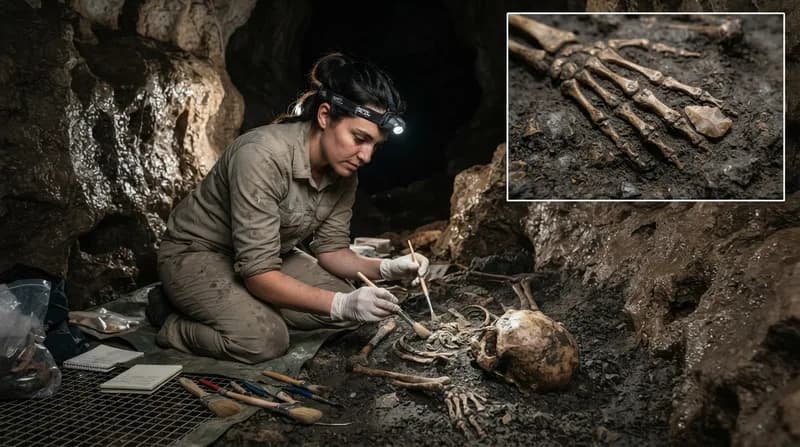
Deep within South Africa's enigmatic Rising Star Cave system, researchers have unearthed a discovery that threatens to rewrite the history of early human-like behavior. Since the initial 2013 discovery of Homo naledi, an extinct human relative that thrived between 335,000 and 241,000 years ago, scientists have been confounded by a recurring physical consistency. The fossils found in the Dinaledi Chamber lacked the typical sexual dimorphism expected in a varied population, presenting a uniform appearance that left anthropologists questioning whether the group was curated or simply biologically unique.

A recent collaborative study involving the University of York and the University of Copenhagen has turned to advanced molecular biology to pierce through the veil of time. By analyzing protein fragments recovered from fossilized tooth enamel, researchers have identified a startling lack of male-specific markers among the 20 individuals analyzed. This discovery suggests the potential for an exclusively female burial site, a cultural phenomenon previously thought to be unique to much more modern species.

The Science of Ancient Proteomics

The success of this investigation relies on the remarkable durability of dental enamel. Unlike bone, which degrades relatively quickly in harsh cave environments, tooth enamel acts as a bio-vault. Its structural density shields internal proteins from environmental degradation and external contamination, preserving biological signatures for hundreds of thousands of years. This allowed the research team to employ a precise, low-damage acid-etching technique to extract peptides without destroying the integrity of the fossils.

The central focus of the analysis was the search for Amelogenin-Y, a protein encoded by a gene located on the male Y chromosome. By systematically searching for this genetic "fingerprint" across 23 teeth, the team confirmed an absence of male-specific protein markers. This result not only provides a high-confidence biological profile of the Dinaledi residents but also stands as the most extensive application of proteomic analysis to an extinct hominin species to date, showcasing a powerful new tool in the field of paleontology.

Implications and Alternative Theories

While the findings point toward a fascinating potential for sophisticated social customs—and perhaps even intentional burial practices—the research team remains cautious. An all-female site would be a landmark discovery, implying that Homo naledi possessed a level of social organization and symbolic behavior previously attributed only to Homo sapiens. The thought that these ancient relatives were consciously segregating their deceased is a radical departure from traditional views of human evolution.

However, scientists are also considering a biological alternative: extreme isolation. It is possible that the population of Homo naledi in this region lived in such a constrained genetic pool that the gene responsible for the Amelogenin-Y protein mutated or vanished entirely. If this were the case, the individuals could have been a mix of sexes despite the lack of male markers. Regardless of the final conclusion, the study proves that we no longer need to rely solely on bone morphology to understand our ancestors. As technology advances, these microscopic proteins are providing a clear, granular window into the social and biological lives of species that vanished long ago.


SPONSORED
The 5 Best Over-Ear ANC Headphones of 2026, Tested & Ranked
Editor's Pick Guide
92/100
Tech & Gadgets•12 min read

The 5 Best Over-Ear ANC Headphones of 2026, Tested & Ranked

We locked five over-ear ANC picks for 2026 — Sony WH-1000XM6, Bose QuietComfort Ultra 2, Soundcore Space One, Sennheiser Momentum 5, and Apple AirPods Max 2 — then stress-tested them on lab metrics, long-term owner truth, and live street prices.

Related Stories

Semantically matched articles, ranked by topic overlap and freshness.

Prehistoric Giant: Fossil Discovery Reveals 66-Pound Rodent from 34 Million Years Ago
Science

Prehistoric Giant: Fossil Discovery Reveals 66-Pound Rodent from 34 Million Years Ago

Paleontologists have unearthed evidence of a massive ancient rodent in Thailand, challenging existing theories on the timeline and geography of rodent gigantism.

New Surgical Protocol: Skipping Morning Blood Pressure Medication Reduces Intraoperative Risks
Science

New Surgical Protocol: Skipping Morning Blood Pressure Medication Reduces Intraoperative Risks

A major clinical trial reveals that withholding ACE inhibitors and ARBs on the day of noncardiac surgery significantly lowers the risk of dangerous intraoperative hypotension in older patients.

Atmospheric Anomaly: Why the Antarctic Ozone Hole Expanded to a Decade-High
Science

Atmospheric Anomaly: Why the Antarctic Ozone Hole Expanded to a Decade-High

Despite a significant seasonal expansion in 2026, climate experts at NASA and NOAA emphasize that the long-term recovery of Earth's ozone layer remains firmly on track.

Infrared Imaging Unlocks the Secret to Sustained Prosthetic Sensation
Science

Infrared Imaging Unlocks the Secret to Sustained Prosthetic Sensation

Researchers are using non-invasive infrared light technology to decode why artificial touch fades over time, paving the way for more reliable prosthetic limbs.

Living Medicine: Repurposed Bacteria Combat Deadly Hospital Biofilms
Science

Living Medicine: Repurposed Bacteria Combat Deadly Hospital Biofilms

Researchers have successfully utilized a genetically modified 'living medicine' to clear antibiotic-resistant bacterial films from ventilation tubes in a landmark animal study.

Jurassic 'Chunk': Scientists Uncover Bizarre New Squid Relative
Science

Jurassic 'Chunk': Scientists Uncover Bizarre New Squid Relative

Paleontologists have identified Wyoteuthis linsterorum, a uniquely robust Jurassic predator that has rewritten our understanding of ancient marine cephalopod evolution.

The Hidden Health Crisis: How Hurricanes Impact Medically Vulnerable Seniors
Science

The Hidden Health Crisis: How Hurricanes Impact Medically Vulnerable Seniors

New research highlights the long-term health consequences for elderly patients relying on electric medical devices in the wake of severe flooding and storm events.

The Predictive Brain: How Modern Neuroscience Validates Freudian Theory
Science

The Predictive Brain: How Modern Neuroscience Validates Freudian Theory

A groundbreaking analysis suggests that the human brain operates as a 'prediction machine,' echoing psychoanalytic concepts proposed by Sigmund Freud over a century ago.