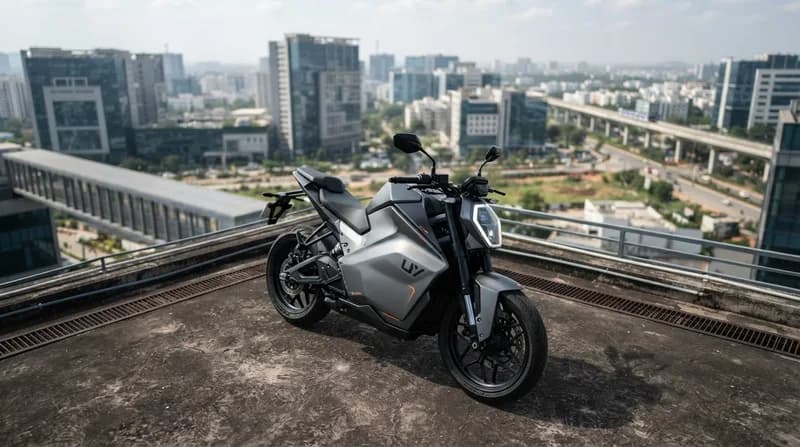
A New Strategy for Indian EVs
Founded in 2016 with heavy backing from industry giants like TVS Motor, Qualcomm Ventures, and TDK Ventures, Bengaluru-based Ultraviolette Automotive has opted for a bold strategy that defies the conventional wisdom of the Indian automotive market. While most manufacturers focus on bottom-up growth—starting with affordable commuter scooters—Ultraviolette chose to tackle the hardest engineering challenges first. By establishing its brand as a premium, high-performance player with the F77 electric motorcycle, the company has successfully bypassed the stigma often associated with "made in India" products, proving that local innovation can stand shoulder-to-shoulder with global icons like Ducati and BMW.
This "top-down" approach has allowed the company to refine core technologies like battery management systems, structural thermals, and vehicle control units under extreme performance conditions. According to Chief Product Officer Vinayak Bhat, the logic is simple: once you engineer a vehicle capable of 300-plus kilometers of range and high-horsepower output, scaling down to more accessible models is a matter of optimization rather than fundamental redesign. This engineering maturity has already paid off, with the company expanding its reach to 19 European countries and making international headlines with its F99 prototype hitting speeds of 258 km/h.
The F77 Mach 2 and Modular Platforms
The F77 remains the cornerstone of the company’s current lineup, but the underlying technology is a modular platform designed for rapid iteration. By decoupling the platform development from specific product cycles, Ultraviolette engineers can create multiple variants, such as the X47 and the SuperStreet, without starting from scratch. This strategy has drastically reduced time-to-market for new iterations.
The company is now leveraging real-world data from over 3 million kilometers of rider usage to drive down costs. By identifying underutilized systems and optimizing componentry, Ultraviolette has managed to lower the price of the F77 significantly since its initial 2022 launch, all while navigating volatile commodity markets and supply chain shifts in the post-pandemic era.
Next-Generation Architectures
Ultraviolette is moving beyond the 48- to 60-volt systems standard in the current industry. The team is currently finalizing the commercialization of India’s first 100-volt e-scooter architecture. This new platform is designed to be highly scalable, supporting both lightweight urban commuters and heavy-duty sports motorcycles.
Simultaneously, the research and development team is working on a high-performance 400-volt architecture. This future-facing project is specifically aimed at the extreme performance segment, where high-voltage efficiency is essential for sustained power delivery. While specific timelines for the delayed Tesseract and Shockwave projects have been adjusted to accommodate the shift toward this more advanced 100-volt framework, the company remains committed to maintaining its position at the bleeding edge of electric mobility.
Why it Matters
- Tech Sovereignty: By developing battery, powertrain, and control units in-house, Ultraviolette avoids the limitations of off-the-shelf components.
- Premium Positioning: Shifting the narrative of Indian manufacturing from "cheap" to "high-performance" opens new doors in global markets.
- Data-Driven Engineering: Using 3 million kilometers of field data allows the company to optimize safety and cost simultaneously, passing value back to the consumer.