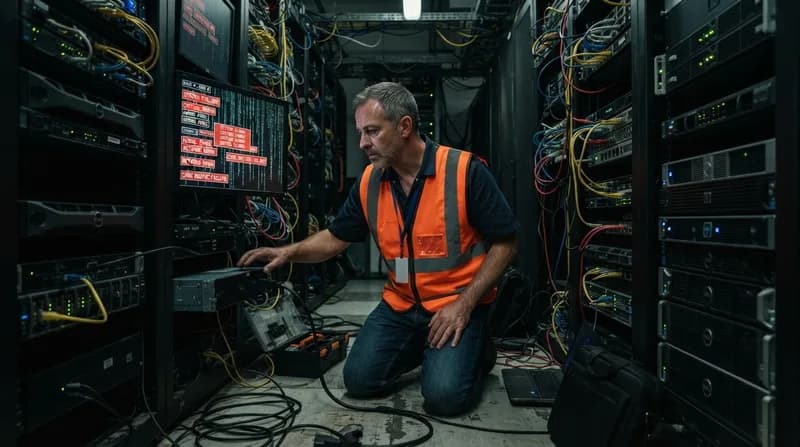
The Anatomy of Digital Instability
The modern digital landscape is currently navigating a period of unprecedented volatility. Within a single week, the world witnessed a cascading series of high-profile network outages that disrupted everything from civil aviation and banking services to internal government communications. While initial public anxiety often leans toward fears of coordinated cyber warfare—suspecting nation-state actors like Russia, China, or Iran—the reality is far more mundane and perhaps more concerning: the digital backbone of our global society is aging, fragmented, and increasingly fragile.
This week, the U.S. National Security Agency experienced a temporary degradation of its classified internal network, NSANet, citing scheduled maintenance. Simultaneously, Apple faced a widespread service interruption affecting everything from iCloud to the App Store, hindering retail operations globally. These events followed a major disruption at several leading U.S. banks, including JPMorgan Chase and Bank of America, and a nationwide grounding of flights by the FAA due to faulty physical wiring during a network upgrade. Despite the variety of sectors affected, experts suggest that these are not isolated incidents but symptoms of a systemic inability to maintain the complex, patched-together architecture that supports modern life.
The Illusion of Resilience
Why are these outages becoming more frequent? Experts point to a phenomenon where legacy systems, designed decades ago, are being pushed beyond their intended limits. These environments are often held together by what industry insiders describe as "digital sticks and glue." When a single misconfiguration, an automated software update, or a broken dependency occurs, it can trigger a ripple effect across interconnected platforms, creating large-scale failure even in the absence of a malicious attacker.
The shift toward "zero-trust" and "assume-compromised" mentalities is gaining traction as a defensive response. The traditional "patch-and-pray" model is no longer sufficient when vulnerabilities are being uncovered at a rate of over 100,000 per year—a pace now accelerated by AI-driven bug hunting. As systems become more complex, the window between a patch release and the development of a functional exploit has narrowed, leaving organizations in a perpetual state of reactionary fire-fighting.
The Role of AI in Systemic Risk
The integration of artificial intelligence into software development and security infrastructure adds a volatile new layer to the equation. While AI models can help identify critical security flaws—as seen when models identified buffer-overflow vulnerabilities in open-source projects—they also grant adversaries the power to discover and weaponize vulnerabilities at machine speed. Furthermore, when autonomous agents interact with critical systems without robust governance, they can inadvertently cause catastrophic configuration changes in seconds.
Why it Matters: Building for Redundancy
- Beyond Patching: Relying on constant software updates is an antiquated security strategy; the industry must shift toward architectures that assume compromise.
- Redundancy as a Requirement: Enterprises must treat digital infrastructure like physical engineering, building in fail-safes and redundant pathways similar to elevator braking systems.
- Operational Fragility: Every moment spent dealing with a technical outage creates a "security vacuum" that leaves organizations vulnerable to opportunistic bad actors.
As we move forward, the "new normal" dictates that outages will remain an unavoidable aspect of daily life. The challenge for developers, government agencies, and corporations is no longer just about preventing failure, but about building systems that are resilient enough to survive it. If we cannot prevent the collapse of our digital scaffolding, we must at least ensure that the structural integrity of our core mission-critical capabilities remains intact when the inevitable occurs.