ScienceTechnical Deep Dive

The Century-Old Mystery Solved: Discovery of 'Altermagnetism' Changes Physics Forever

Published
EElectricBuzz Editorial Team
The Century-Old Mystery Solved: Discovery of 'Altermagnetism' Changes Physics Forever
3 min read489 wordsElectricBuzz Editorial Team

The Gist

“Physicists have identified a hidden third form of magnetism that remained undetected for over 100 years, earning a prestigious Europhysics Prize for the discovery.”

A Paradigm Shift in Magnetic Theory

For more than a century, the scientific understanding of magnetism was neatly categorized into two distinct buckets: ferromagnetism and antiferromagnetism. Ferromagnets, which align their internal magnetic moments to produce a net field, are the backbone of today's magnetic memory technologies. Antiferromagnets, conversely, feature opposing magnetic moments that perfectly cancel each other out, resulting in a zero net magnetic field. This binary framework has dominated physics textbooks for generations—until now.

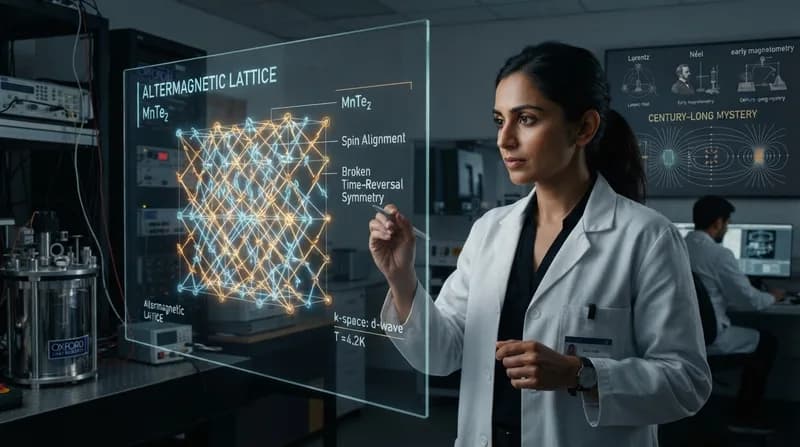
A team of researchers led by Professor Jairo Sinova, Dr. Libor Šmejkal, and Professor Tomas Jungwirth has officially shattered this paradigm by discovering a third, long-hidden category of magnetism known as altermagnetism. This breakthrough, which was recently honored with the prestigious 2026 Europhysics Prize, reveals that matter can possess a unique symmetry in its electron distribution, enabling properties that defy traditional categorization.

Understanding Altermagnetism

At its core, altermagnetism acts as a bridge between the two known magnetic states. Like traditional antiferromagnets, these materials exhibit magnetic moments that cancel each other out, meaning they do not produce a net magnetization that would attract a paperclip. However, at the subatomic level, their electron behavior mirrors the desirable characteristics of ferromagnets.

This unconventional combination is significant because it allows altermagnets to support electrical currents with strongly polarized electron spins while simultaneously maintaining the rapid magnetic dynamics typically seen in antiferromagnets. Because the magnetic moments are canceled, these materials are not as susceptible to external magnetic fields as ferromagnets, offering a more stable yet highly responsive medium for data manipulation.

Why It Matters

  • Revolutionizing Computing: By utilizing the spin of electrons (spintronics), altermagnets could lead to significantly faster and more energy-efficient computer memory and processing components.
  • Broadening Quantum Research: The discovery provides a new framework for understanding topological phenomena and unconventional superconductivity, opening doors to materials that were previously deemed impossible.
  • Redefining Fundamental Physics: It proves that even in highly mature scientific fields, fundamental behaviors can remain hidden in plain sight due to our rigid reliance on historical symmetry classifications.

From Theory to Experimental Reality

The journey to this discovery began with a deep dive into the theoretical limits of how electricity travels through magnetic crystals. Through years of collaborative research between the Johannes Gutenberg University Mainz and the Institute of Physics of the Czech Academy of Sciences, the researchers moved beyond studying individual material anomalies and began mapping a broader symmetry-based principle of electron spin. By 2022, they had successfully classified the mathematical symmetry of altermagnetism and identified hundreds of potential materials that could harbor this phenomenon.

Experimental verification followed quickly, with teams globally employing angle-resolved photoemission spectroscopy (ARPES) to observe how electrons behave within the crystal structures of these materials. The data confirmed the existence of altermagnetism, transforming the concept from a mathematical hypothesis into one of the most active and exciting frontiers in modern condensed matter physics. As researchers continue to explore these materials, the potential for next-generation information technology seems more attainable than ever.

SPONSORED
The 5 Best Over-Ear ANC Headphones of 2026, Tested & Ranked
Editor's Pick Guide
92/100
Tech & Gadgets•12 min read

The 5 Best Over-Ear ANC Headphones of 2026, Tested & Ranked

We locked five over-ear ANC picks for 2026 — Sony WH-1000XM6, Bose QuietComfort Ultra 2, Soundcore Space One, Sennheiser Momentum 5, and Apple AirPods Max 2 — then stress-tested them on lab metrics, long-term owner truth, and live street prices.

Related Stories

Semantically matched articles, ranked by topic overlap and freshness.

New Clinical Trial Validates Exercise as a Drug-Free Tool for Spinal Cord Injury Pain
Science

New Clinical Trial Validates Exercise as a Drug-Free Tool for Spinal Cord Injury Pain

A landmark study from the University of British Columbia reveals that personalized exercise programs can significantly mitigate chronic pain for individuals with spinal cord injuries.

Psychedelic Breakthrough: Magic Mushroom Compound Mutes Aggression in Fish
Science

Psychedelic Breakthrough: Magic Mushroom Compound Mutes Aggression in Fish

A groundbreaking study reveals that psilocybin can selectively dampen aggressive behaviors in fish, offering new biological insights into how the compound affects social regulation.

Evolving Omicron: Researchers Uncover Divergent Infection Strategies in SARS-CoV-2 Variants
Science

Evolving Omicron: Researchers Uncover Divergent Infection Strategies in SARS-CoV-2 Variants

New research from HKUMed reveals that emerging SARS-CoV-2 variants are adopting distinct biological pathways, with some targeting the lungs while others demonstrate a surprising efficiency in colonizing the human gut.

Could a Hidden Sugar in Red Meat Be Driving Diabetes Risk?
Science

Could a Hidden Sugar in Red Meat Be Driving Diabetes Risk?

A major new study reveals that N-glycolylneuraminic acid (Neu5Gc), a sugar found in beef and lamb, may trigger systemic inflammation and significantly elevate the risk of type 2 diabetes.

Quantum Breakthrough: Physicists Discover the 'Fractional Fermi Sea'
Science

Quantum Breakthrough: Physicists Discover the 'Fractional Fermi Sea'

Researchers have engineered a bizarre, highly excited state of matter where ultracold atoms defy traditional quantum rules while maintaining a hidden, orderly structure.

The 1960 Doomsday Forecast: Why the World Won’t End on November 13, 2026
Science

The 1960 Doomsday Forecast: Why the World Won’t End on November 13, 2026

A deep dive into the infamous 'Doomsday' prediction that captivated the world for decades, blending rigorous mathematics with the art of theatrical misdirection.

Could Silence Be the Best Medicine? The Surprising Link Between Headphones and Post-Surgery Recovery
Science

Could Silence Be the Best Medicine? The Surprising Link Between Headphones and Post-Surgery Recovery

A new clinical trial suggests that wearing noise-canceling headphones during surgery significantly reduces postoperative nausea and vomiting, offering a non-pharmacological path to better patient recovery.

Antarctic Sea Ice: A Critical Shift in the Frozen Frontier
Science

Antarctic Sea Ice: A Critical Shift in the Frozen Frontier

New satellite data reveals that Antarctic sea ice has hit its third-lowest winter maximum on record, signaling a potentially permanent departure from past growth trends.