A New Frontier in Quantum Matter
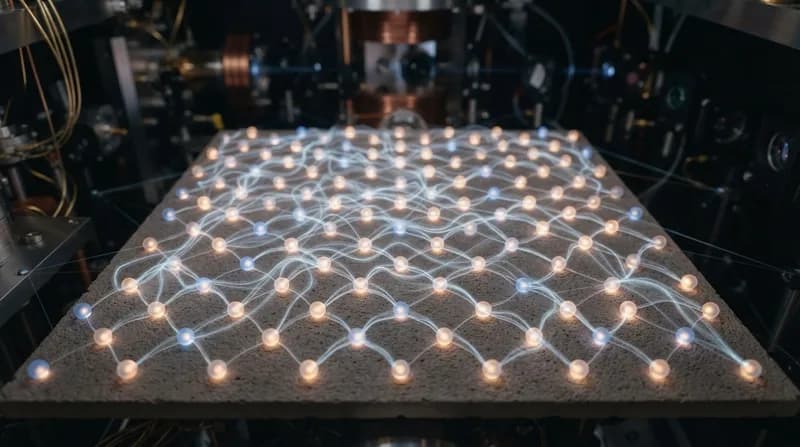
In a discovery that challenges the bedrock of established quantum theory, physicists at the University of Innsbruck have successfully created a previously theoretical state of matter dubbed the 'fractional Fermi sea.' By manipulating ultracold cesium atoms within a highly controlled one-dimensional environment, the team has managed to push quantum particles into a state that is both intensely energetic and surprisingly structured.
Typically, quantum systems follow specific organizational patterns. Fermions—particles like electrons—naturally occupy energy levels in a rigid, orderly fashion known as a Fermi sea. However, this new research demonstrates that by cycling these atoms through rapid, repeated shifts between attractive and repulsive interactions, researchers can force the system into a configuration that breaks standard paradigms. Instead of descending into chaotic, thermalized disorder, the atoms rearrange themselves into a state that exhibits a unique, hidden form of order.
The Mechanics of Hidden Order
The core of this breakthrough lies in the ability to drive a system far from its natural equilibrium. Under standard conditions, systems tend to settle into a stable state. By contrast, the fractional Fermi sea is highly excited, yet it retains distinctive mathematical fingerprints. Among these are Friedel oscillations—wave-like patterns that reveal how quantum particles influence one another over distance.
These patterns provide a crucial departure from the long-standing Tomonaga-Luttinger liquid theory, which has traditionally been the go-to framework for understanding one-dimensional quantum systems. The failure of existing models to fully explain these observations suggests that the fractional Fermi sea belongs to an entirely new class of critical quantum phases. Furthermore, the researchers have observed collective excitations within this state that behave so uniquely they are already considering labeling these emergent entities 'super-Fermions.'
Why It Matters
- Beyond Equilibrium: This research demonstrates that scientists can now explore matter far from the limits of traditional equilibrium, opening new doors for understanding high-energy quantum states.
- Redefining Theory: The discovery challenges the universality of current models like the Tomonaga-Luttinger liquid, forcing a potential rewrite of how we view interacting particles in 1D systems.
- Quantum Simulation Power: The study highlights the precision of modern quantum simulation, proving that researchers can engineer and probe states that have never existed in nature, rather than simply observing those predicted by standard models.
- Emergent Quasiparticles: The potential existence of 'super-Fermions' suggests that we may be on the verge of discovering new classes of quasiparticles that could have implications for future quantum computing hardware.
The team, led by Hanns-Christoph Nägerl, views this as a landmark moment in quantum simulation. By moving beyond merely reproducing known phenomena, the ability to create and test these exotic states provides a powerful new toolkit for studying the universe's most fundamental interactions. As the team's experimental findings move through the peer-review process, the scientific community is already looking toward the next phase of this work: identifying exactly how these 'super-Fermions' function and whether this hidden order can be leveraged in practical quantum applications.