The Quest for Stable Quantum Architecture
Quantum computing stands at a precipice. While the potential for exponential leaps in processing power is well-documented, the industry is currently stifled by the fragility of the qubit. Today’s most prominent quantum systems typically rely on superconducting circuits, which are notoriously susceptible to environmental interference. Even minor electromagnetic noise or stray electrical charges can cause decoherence, effectively wiping out quantum information and resulting in high error rates. As developers attempt to scale up to larger, more complex systems, controlling these errors has become the single most significant roadblock to the next generation of computing.
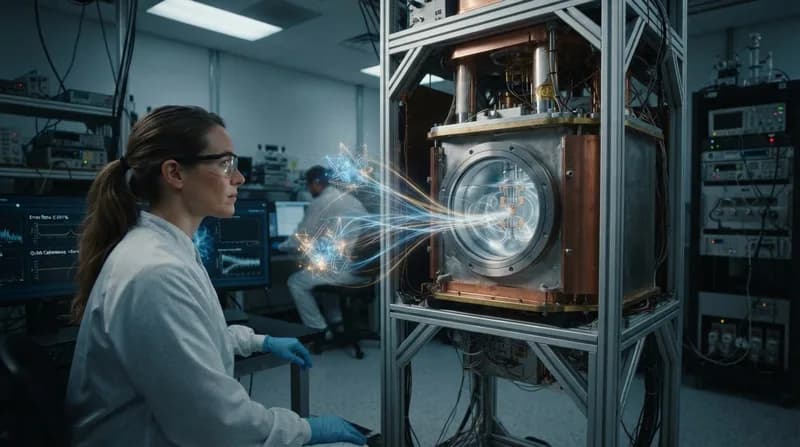
A team from the University of Surrey is aiming to change that narrative through the development of the Superfluid Helium Oscillator Quantum (SHOQ) device. By shifting the paradigm away from purely electronic circuits toward a superfluid-based system, researchers are exploring a material that possesses unique, friction-less properties capable of isolating quantum states from the background "static" that plagues modern hardware.
The Mechanics of the SHOQ Device
The innovation lies in the use of superfluid helium-3, a state of matter that exhibits quantum phenomena on a macroscopic scale. The proposed SHOQ device leverages the charge-neutral nature of this fluid. Because the superfluid does not carry an electric charge, it is inherently shielded from the electromagnetic fluctuations that frequently disrupt superconducting qubits. This physical architecture effectively creates a localized, noise-resistant environment for quantum data.
Theoretical calculations suggest that this breakthrough could reduce error rates by approximately 100-fold compared to traditional superconducting designs. By bringing together advanced microfluidic technology with the intrinsic properties of helium-3, the research team has mapped out a viable path for constructing a qubit that functions with unprecedented stability. The math indicates that the device is not only theoretically sound but also physically achievable with current cryogenic capabilities.
Why It Matters: A Hybrid Future
The ambition behind the SHOQ device is not necessarily to replace existing infrastructure, but to augment it. Experts envision a hybrid future where different types of qubits coexist within a single system to maximize efficiency. In this model, superconducting circuits might continue to handle high-speed calculation tasks, while superfluid-based qubits serve as robust quantum memory units.
- Noise Immunity: The charge-neutral profile of superfluid helium provides a natural barrier against ambient electromagnetic interference.
- Scalability: By lowering error rates, the design could simplify the complexity of quantum error correction required for large-scale machines.
- Hybrid Integration: The architecture is designed to function alongside, rather than in place of, current superconducting quantum standards.
The research, published in npj Quantum Information, represents a collaborative effort between the University of Surrey and Northwestern University, involving experts who were instrumental in the development of the transmon qubit. With the feasibility study complete, the team is now moving toward the development of a physical prototype. This next phase aims to validate the predicted performance in a lab setting, utilizing the specialized ultra-cold conditions where superfluid helium-3 is known to thrive. If successful, this innovation could provide the high-fidelity memory architecture that has remained one of the final pieces of the quantum puzzle.