Testing the Foundations of Physics
Since its monumental discovery in 2012, the Higgs boson has remained the central figure in our quest to understand why matter possesses mass. Often referred to as the 'God particle,' this fundamental boson is the manifestation of the Higgs field, a pervasive energy web that imparts mass to elementary particles. While theoretical physics predicted its existence in the 1960s, the recent and most comprehensive study conducted by the CMS (Compact Muon Solenoid) collaboration at the Large Hadron Collider provides the most rigorous validation of these theories to date.
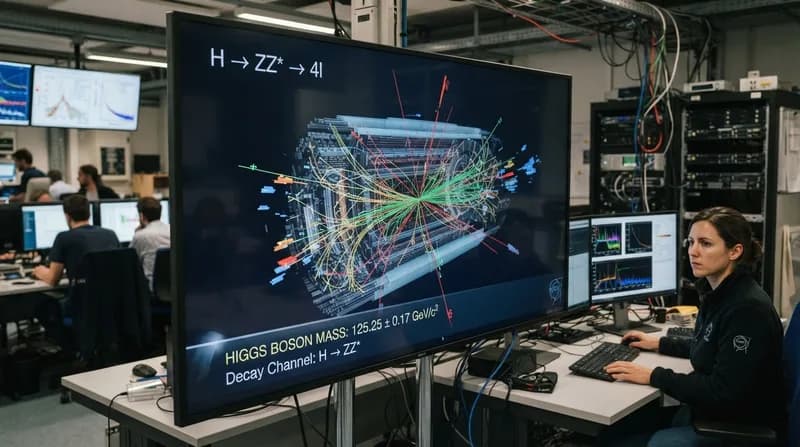
By aggregating a massive dataset of proton-proton collisions spanning from 2016 to 2018, researchers processed 138 inverse femtobarns of data. This incredible depth of information allowed the team to scrutinize Higgs boson behavior with unprecedented clarity, measuring production rates, decay channels, and interactions with other particles to ensure they remain consistent with the long-established Standard Model.
Key Findings and Technical Scope
The study went beyond basic observations, delving into rare decay patterns and exotic scenarios that could have hinted at new, undiscovered physics. Key areas of focus included:
- Decay Channel Analysis: Researchers examined a broad spectrum of decay paths, including transitions into photons, Z-bosons, and various leptons, to map out the particle's complete lifecycle.
- Invisible Decays: The team specifically looked for 'invisible' decays, which could potentially signal the presence of dark matter candidates interacting with the Higgs field.
- Off-shell Production: The study also investigated the Higgs in a virtual, off-shell state, where it exhibits a mass distinct from its traditional physical resting mass.
- Signal Strength Accuracy: The team calculated an overall Higgs signal strength of 1.01 ± 0.05. Given that a value of 1.00 represents a perfect alignment with the Standard Model, this 5% precision confirms that the particle is behaving exactly as theory demands.
Why It Matters
The significance of this research lies in its role as a gatekeeper for future physics. Many alternative theories—those suggesting extra dimensions, supersymmetry, or exotic forces—rely on the idea that the Higgs boson deviates slightly from Standard Model predictions. By confirming the Higgs behaves with such precise adherence to established laws, this study effectively shrinks the 'discovery space' for these alternative theories. It acts as a clear roadmap for future researchers at the Large Hadron Collider and other facilities, narrowing the search parameters to areas where new physics might still be hiding.
As noted by Dr. Jonathon Langford, this milestone represents a profound leap in capability. In just over a decade, we have moved from merely confirming the existence of the particle to measuring its production rate with a 5% margin of error, cementing our understanding of the origins of mass within the universe.