ScienceTechnical Deep Dive

Solving the Mystery of Earth’s Vanishing Billion Years

Published
EElectricBuzz Editorial Team
Solving the Mystery of Earth’s Vanishing Billion Years
3 min read463 wordsElectricBuzz Editorial Team

The Gist

“A groundbreaking study suggests that slow, powerful movements deep within Earth’s mantle may have literally erased over a billion years of geological history.”

A Lost Chapter in Planetary History

For decades, geologists have been haunted by a missing chapter in Earth's history: the "Great Unconformity." Across the globe, from the iconic walls of the Grand Canyon to outcrops in Europe and Asia, there exists a jarring geological gap. In these locations, sedimentary rock from the Cambrian period—roughly 540 million years ago—sits directly atop crystalline rock that can be over a billion years older. Between these layers, hundreds of millions, sometimes over a billion, years of geological narrative have simply vanished.

New research published in the journal Nature offers a compelling, unified explanation for this puzzle. Led by a team at the University of Wollongong, scientists suggest that this missing time was not a matter of geological bad luck, but the result of massive, invisible forces working from deep within the planet's interior. By simulating the long-term behavior of Earth’s mantle, researchers have identified a mechanism that effectively "ripped out" the pages of our planet's history book.

The Role of Mantle Convection

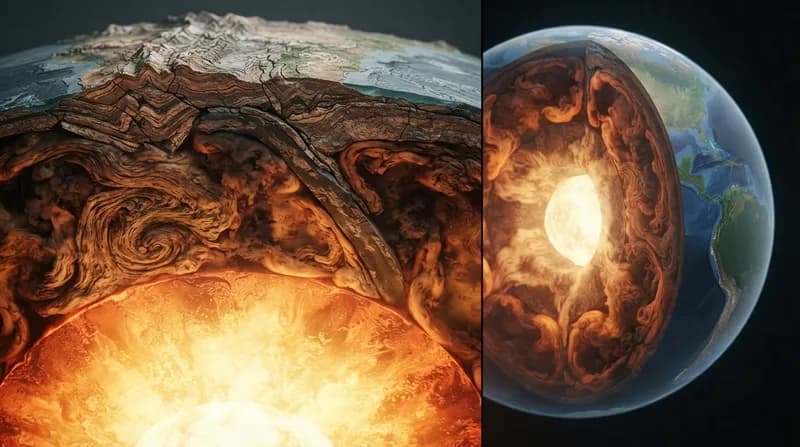
At the heart of this discovery is the process of mantle convection. While the Earth's mantle—the massive layer of hot rock between the crust and the core—may seem solid on a human scale, it behaves like a viscous fluid over millions of years. This slow, heat-driven circulation acts as a colossal conveyor belt, capable of lifting entire continental landmasses or dragging them down into subsidence.

The study’s simulations revealed that during the Neoproterozoic Era, between one billion and 540 million years ago, the cores of major continents like Laurentia (North America), Baltica (Northern Europe), and North China were pushed upward by mantle convection. This period of sustained elevation exposed these ancient landmasses to the relentless forces of wind, rain, and water. As the continents remained high, these natural processes eroded vast, kilometer-thick sequences of ancient rock, erasing the evidence of the preceding millions of years.

Preservation Through Subsidence

The final piece of the puzzle lies in what happened after the erosion. Following this prolonged period of uplift, the same mantle forces caused these continental regions to subside. As the land sank, rising seas flooded the eroded surfaces, creating the perfect conditions for new sediment to accumulate on top of the ancient granite basement. This sequence of uplift, massive erosion, and eventual burial created the sharp, distinct boundary geologists observe today.

The research is significant because it provides a testable model that aligns with the global distribution of the Great Unconformity. Rather than attributing the phenomenon to localized events, this study suggests that deep-Earth dynamics were the primary driver. By connecting surface-level rock formations to the slow, churning movements of the mantle far below, scientists have finally provided a coherent, evidence-based framework to explain one of the most enduring mysteries in the study of Earth's evolution.


SPONSORED
The 5 Best Over-Ear ANC Headphones of 2026, Tested & Ranked
Editor's Pick Guide
92/100
Tech & Gadgets•12 min read

The 5 Best Over-Ear ANC Headphones of 2026, Tested & Ranked

We locked five over-ear ANC picks for 2026 — Sony WH-1000XM6, Bose QuietComfort Ultra 2, Soundcore Space One, Sennheiser Momentum 5, and Apple AirPods Max 2 — then stress-tested them on lab metrics, long-term owner truth, and live street prices.

Related Stories

Semantically matched articles, ranked by topic overlap and freshness.

Lubdub Moves Wearable ECG Technology from Research Lab to Clinical Trial
Science

Lubdub Moves Wearable ECG Technology from Research Lab to Clinical Trial

A new gel-free, waterproof wearable patch developed by RMIT University spin-off Lubdub aims to streamline cardiac monitoring and bridge the gap between early symptoms and professional diagnosis.

New Metabolic Compound Boosts Fat Burning While Preserving Muscle Mass
Science

New Metabolic Compound Boosts Fat Burning While Preserving Muscle Mass

Researchers at UC Berkeley have discovered a breakthrough compound that increases energy expenditure without the muscle loss often associated with current weight-loss drugs.

Unlocking a New Target: How Brain Development Clues Could Combat Glioblastoma
Science

Unlocking a New Target: How Brain Development Clues Could Combat Glioblastoma

Researchers at Mount Sinai have uncovered a common molecular vulnerability in aggressive brain tumors that mirrors early development, potentially paving the way for revolutionary new therapies.

Silicon Quantum Computing: Precision Engineering at the Atomic Scale
Science

Silicon Quantum Computing: Precision Engineering at the Atomic Scale

Silicon Quantum Computing is revolutionizing the industry by harnessing individual phosphorous atoms to create high-fidelity, scalable quantum processors.

China Prepares for Historic International Mission to Tiangong Space Station
Science

China Prepares for Historic International Mission to Tiangong Space Station

As the Shenzhou-24 mission rolls to the launchpad, China prepares to welcome its first-ever international astronaut to the Tiangong space station.

MIT Engineers Unveil Breakthrough Gel-Free Ultrasound Patch
Science

MIT Engineers Unveil Breakthrough Gel-Free Ultrasound Patch

A revolutionary new 'bottlebrush' polymer material could transform wearable medical imaging by eliminating the need for traditional, messy ultrasound gels.

Decoding the Neural Blueprint: A New Era for Speech Neuroscience
Science

Decoding the Neural Blueprint: A New Era for Speech Neuroscience

Researchers at UCSF have uncovered a critical brain region that functions as a blueprint for spoken language, potentially revolutionizing brain-computer interface technology.

Hidden Mycological Markers: The Reality of Fungal Toxins in Plant-Based Foods
Science

Hidden Mycological Markers: The Reality of Fungal Toxins in Plant-Based Foods

A comprehensive study of over 200 plant-based products reveals the presence of naturally occurring fungal toxins, prompting a closer look at long-term dietary exposure.