Solving the Solar Wind Puzzle
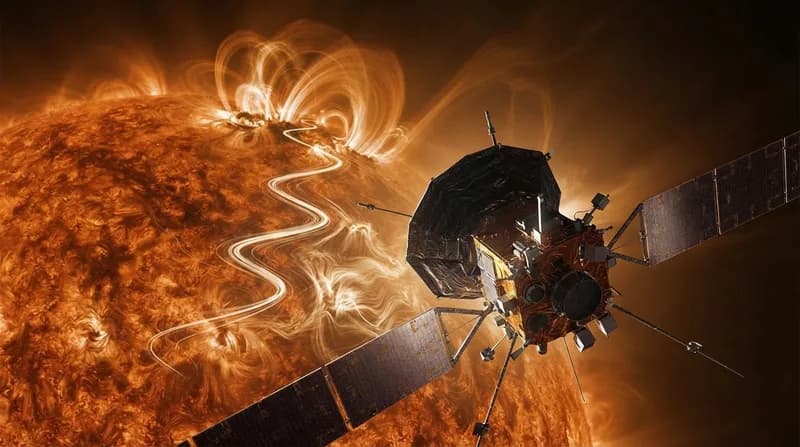
For years, heliophysicists have been captivated by the mysterious appearance of "switchbacks"—sharp, S-shaped kinks in the magnetic field lines that permeate the solar wind. While these structures have been observed regularly by space-faring probes, their exact origins remained one of the most persistent debates in solar science. Recent data captured by the European Space Agency’s (ESA) Solar Orbiter has provided the definitive smoking gun needed to settle the controversy, tracing these disturbances back to their violent birth at the Sun's surface.
By flying directly through a massive switchback, the Solar Orbiter was able to sample unique plasma particles that carry the distinct chemical fingerprints of their origin point. The mission utilized its sophisticated Solar Wind Analyser (SWA) to confirm that these particles could only have formed within the intense, hot magnetic loops found at the solar surface. This discovery validates the theory of "interchange reconnection," a process where magnetic field lines of varying properties collide and snap, releasing trapped plasma into the solar atmosphere.
Why It Matters
- Understanding Solar Dynamics: This breakthrough clarifies how the Sun heats its corona and accelerates solar wind, which is critical for our fundamental understanding of stellar physics.
- Space Weather Forecasting: By mastering the mechanics of the solar wind, scientists can better predict the severity of solar storms, allowing for improved protection of satellite infrastructure and power grids on Earth.
- Validation of Theory: The findings provide clear evidence that while interchange reconnection creates the switchback at the surface, secondary atmospheric waves and turbulence govern the structure's behavior as it travels through interplanetary space.
The Mechanics of Interchange Reconnection
The study reveals that the Sun is not a static object but a chaotic environment of interacting magnetic fields. Some field lines are "open," stretching far out into the cosmos, while others are "closed," looping back onto the Sun's surface. When an open field line encounters a closed loop, the magnetic reconnection event acts as a slingshot, launching matter outward and warping the magnetic field into that signature S-shape.
Researchers involved in the study, including representatives from the French National Center for Scientific Research and Northumbria University, emphasized that this is a multi-stage process. Once these magnetic kinks escape the Sun's surface, they are no longer just products of reconnection; they become subject to the turbulent environment of space. This dual-layer understanding of solar behavior represents a significant leap forward in solar observation, moving the field from mere speculation toward a predictive science.
As our reliance on space-based technology grows, from global GPS systems to satellite-based internet constellations, the ability to anticipate and track these solar phenomena becomes increasingly vital. The Solar Orbiter mission continues to prove that our proximity to the Sun is not just a source of energy, but a complex relationship that requires constant, high-precision monitoring to ensure the safety of our technological civilization.