Bringing LLMs to the 16-Bit Era
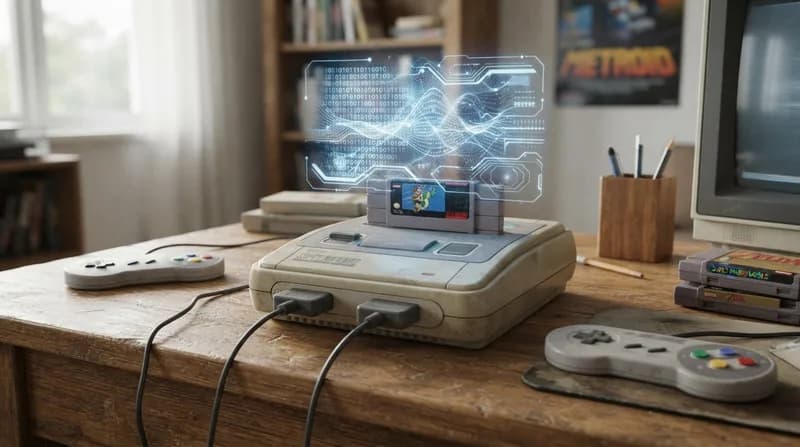
In a fascinating intersection of modern machine learning and classic gaming hardware, tech journalist and retro enthusiast Benj Edwards has unveiled 'ChatGPT for SNES.' This project represents a technical milestone in the world of 'tiny AI,' proving that even the modest hardware of a 1990s-era Super Nintendo console can support the basic framework of a large language model. By stripping down the architecture of OpenAI’s GPT-OSS-120b model, Edwards managed to distill a 2.2-million-parameter version capable of running within an emulator or on physical vintage hardware.
The project is not intended to rival modern, cloud-based AI assistants in intelligence or utility. Instead, it serves as a whimsical exploration of constraints. The model is intentionally tiny, possessing a vocabulary of roughly 8,000 words. Because of this massive reduction in scale, the AI often provides responses that are nonsensical or factually incorrect—though, as Edwards notes, these 'hallucinations' are part of the charm when presented with the nostalgic aesthetics of a Super Nintendo interface.
Hardware and Software Specifications
To make this vision a reality, Edwards developed two distinct versions of the software. The first is a 'pure' model that relies entirely on the internal parameters of the AI to generate text, allowing it to run on a standard, albeit custom, SNES cartridge. The second iteration includes a 'fact book'—a curated database derived from the opening sentences of 150,000 simple English Wikipedia articles. This version significantly improves the coherence and accuracy of the AI, though it requires more advanced hardware overhead.
For those looking to experience the experiment on authentic hardware, specific requirements must be met. The base version requires a flash cartridge capable of running custom ROMs, such as the FXPak Pro or SD2SNES. To handle the more complex 'fact book' build, the console must also support the Media Streaming Unit 1 (MSU-1), an aftermarket expansion that grants the SNES CD-ROM-like data access speeds. While the base model can run without the Super FX graphics coprocessor, Edwards notes that utilizing the chip allows for a more robust processing environment that elevates the responsiveness of the AI.
The Future of Tiny AI
The creation of 'ChatGPT for SNES' was a true collaborative effort between human creativity and AI-assisted engineering. Edwards acted as the architect, defining the scope, visual design, and user interface, while leveraging coding agents to handle the heavy lifting of the implementation. This approach highlights a growing trend of human-AI synergy, where humans provide the creative vision and context, and AI tools facilitate the execution of complex technical tasks.
Looking ahead, the potential for 'tiny talking machines' remains an open frontier. While current AI agents suggest that the SNES hardware has reached its logical limit for model performance, Edwards remains skeptical of these constraints. He is already conceptualizing new methods to improve the coherence of these miniature models, aiming to prove that human ingenuity can continue to push the boundaries of what is possible on legacy hardware. As we move deeper into the era of specialized AI, projects like this remind us that technology can be as much about play and experimentation as it is about practical utility.