Revitalizing the Iberian Industrial Hub
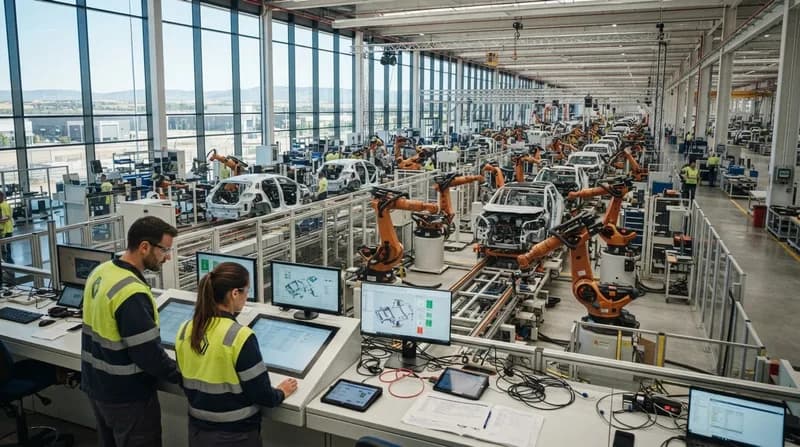
Renault has officially pulled the curtain back on an ambitious €600 million investment plan aimed at transforming its production facilities in Valladolid and Palencia, Spain. This financial injection, set to unfold through 2030, marks a significant milestone in the company's broader futuREady strategic roadmap. By modernizing these critical sites, the automaker aims to secure long-term competitiveness and cement its status as a cornerstone of the European electric vehicle manufacturing ecosystem.
The project is backed by a combination of internal Renault capital and vital subsidies from both the Spanish national government and the regional administration of Castile and León. Beyond mere facility upgrades, the investment ensures the stability of 6,000 local jobs, supported by a long-term collective bargaining agreement that runs through 2028. This move signifies that Renault views Spain as a fundamental pillar of its future, rather than just an extension of its French manufacturing core.
The RGEV Medium 2.0 Platform
Central to this industrial evolution is the deployment of Renault’s next-generation architecture: the RGEV Medium 2.0 platform. Representing a major leap over current EV underpinnings, this platform is engineered for maximum versatility, accommodating everything from agile B-segment city cars to robust D-segment SUVs, vans, and MPVs. Its most striking feature is an 800-volt electrical architecture, which is rapidly becoming the gold standard for high-performance electric motoring.
Technical highlights of the RGEV Medium 2.0 platform include:
- Ultra-Fast Charging: Capable of achieving significant range in just 10 minutes at the plug.
- Extreme Versatility: Modular design that supports diverse body styles across multiple segments.
- Exceptional Range: Offers up to 750 km on a single charge for pure battery-electric vehicles, extending to a staggering 1,400 km in range-extender configurations.
- Performance Scalability: Engineered to balance efficiency and power output across different vehicle sizes.
Strategic Expansion and Production Goals
The modernization effort includes the production of five new models, with a dedicated focus on the C-segment EV market. While Renault remains tight-lipped on the exact lineup, the integration of a new battery assembly line in Valladolid underscores the shift toward localized, vertical integration. This ensures that the essential "heart" of the vehicle—the battery pack—is built in close proximity to the final assembly line, streamlining logistics and reducing the carbon footprint of the production chain.
While Renault’s journey into mass-market electrification began with its ElectriCity hub in northern France, this Spanish initiative proves the company is diversifying its geographic risk. With production sites already operating in Slovenia and now deeply embedding advanced EV technology in Spain, Renault is building a resilient, multi-national network. As the automotive industry faces turbulent shifts, this strategic move is designed to ensure that Renault remains not just a participant, but a leader in the global transition to sustainable mobility.