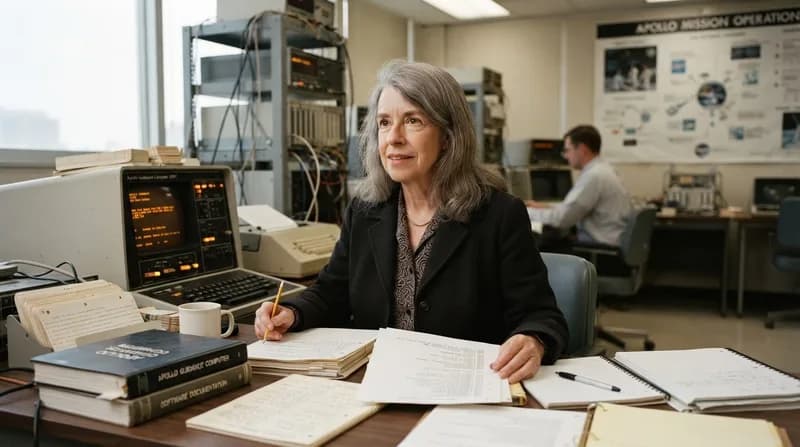
A Legacy Built on Code
The history of space exploration is often told through the lens of thrusters, heat shields, and brave pilots, but one of the most critical components of the Apollo missions was written in code. Margaret Hamilton, a pioneering computer scientist who led the development of the onboard flight software for NASA's Apollo lunar and command modules, passed away on September 30 at the age of 90. Her work did more than just guide astronauts to the Moon; it laid the very foundation for what we now understand as modern, ultra-reliable software engineering.
Hamilton's journey began at the MIT Instrumentation Laboratory in 1965. In an era where software development was frequently dismissed as a secondary task compared to physical hardware, Hamilton famously insisted on the title of "software engineer." Her foresight proved invaluable during the tension-filled descent of Apollo 11. As the lunar module approached the surface, the guidance computer began flagging "executive overflows." Thanks to the robust, priority-based architecture Hamilton and her team designed, the computer was able to ignore lower-priority tasks and focus on the mission-critical landing data, allowing Neil Armstrong and Buzz Aldrin to touch down safely.
The Philosophy of 'Forget It'
One of Hamilton's most enduring professional traits was her commitment to planning for the "impossible" failure. She once famously developed a program she labeled "Forget It" for an abort procedure. Initially, colleagues deemed the code unnecessary, arguing that the specific scenario it addressed would never occur. However, when an unmanned mission eventually hit that exact scenario, the code executed flawlessly, instantly cementing Hamilton's reputation as a master of fault-tolerant design.
This philosophy of defensive programming carried over into the human-machine interface as well. After her young daughter accidentally triggered a pre-launch sequence during a simulation, Hamilton advocated for software safeguards that could prevent operator error. Although initially met with skepticism by those who believed astronauts would not make such mistakes, subsequent real-world incidents validated her approach. These "human-in-the-loop" design principles became a cornerstone of mission safety, ensuring the software served the astronaut rather than constraining them.
Why Her Work Matters
- Pioneering Discipline: Hamilton literally invented the role of "software engineer," elevating code to the same level of rigorous discipline as aerospace or electrical engineering.
- Fault-Tolerance: Her methodologies introduced the concept of asynchronous software and priority scheduling, which are now ubiquitous in modern computing environments.
- Design Philosophy: She championed the idea of building systems that account for the "unlikely" human error, a concept that continues to save lives in aviation, medical technology, and autonomous vehicle design today.
- Recognition: In 2016, her monumental contributions were formally recognized when she was awarded the Presidential Medal of Freedom, the highest civilian honor in the United States.
Beyond the Apollo program, Hamilton’s influence permeated the industry. She founded several technology companies focused on fault-tolerant systems and developed the Universal Systems Language (USL) for systems design. Her iconic photograph, standing next to a stack of Apollo source code that matched her own height, remains one of the most powerful images in computer science. Margaret Hamilton leaves behind not just a legacy of spaceflight, but a roadmap for how to build software that is resilient enough to endure the extremes of space and the unpredictability of human nature.