A New Rhythm in Quantum Computing
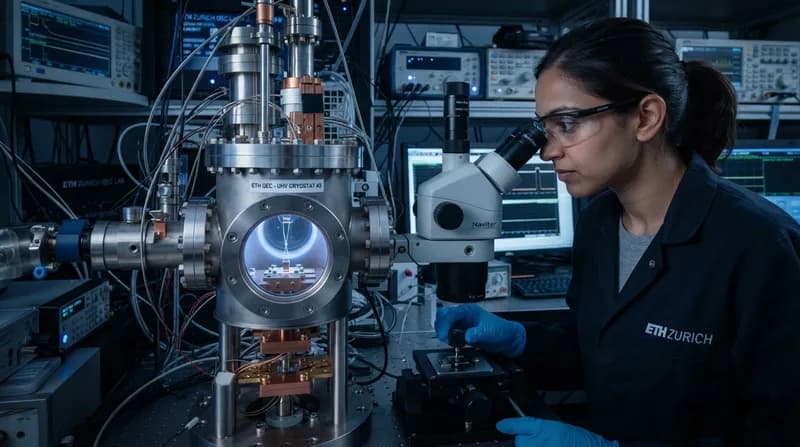
In a significant leap for quantum architecture, a research team at ETH Zurich has pioneered a method for storing quantum information using microscopic mechanical vibrations. By drawing an analogy to the strings of a guitar, lead physicist Yiwen Chu and her colleagues have demonstrated that these high-frequency, non-audible vibrations can serve as a highly efficient and stable form of working memory within a quantum system. This development addresses one of the most persistent bottlenecks in the field: the size and complexity of current quantum memory storage.
Traditional quantum computers often struggle with the footprint of their components. Electromagnetic memory, while well-understood, can be cumbersome, occupying substantial space that limits the scalability of experimental machines. By shifting to mechanical resonators—tiny structures that vibrate in controlled, precise patterns—the team has introduced a pathway to more compact, dense, and potentially more durable quantum architectures that can maintain coherence for longer durations.
Reframing the Quantum CPU Architecture
The researchers adopted a design philosophy borrowed from classical computing, where a distinct separation exists between the processing unit and the volatile memory. In this novel setup, a superconducting qubit performs the heavy lifting, acting as the CPU, while the mechanical resonators function as the RAM. This modular approach allows the system to offload information into the vibrating structure, perform operations, and retrieve the data, all while keeping the fragile quantum states protected from external noise.
This is not merely a theoretical exercise. The team successfully executed fundamental quantum algorithms, including the quantum Fourier transform and period-finding, within this vibration-based environment. These tests confirmed that the mechanical resonators are not just passive storage units; they are capable of interacting with the processing unit with the precision required for genuine, complex quantum computation. By proving that mechanical vibrations can hold and manipulate quantum information effectively, the study establishes a viable, scalable alternative to conventional electromagnetic storage methods.
Why It Matters
- Reduced Footprint: Mechanical resonators are significantly smaller than traditional electromagnetic storage, enabling more dense and scalable quantum hardware.
- Extended Coherence: Mechanical vibrations provide superior stability, potentially preserving quantum states for longer periods and facilitating more reliable multi-step calculations.
- Architectural Versatility: The separation of processor and memory mimics standard computing paradigms, offering a clearer roadmap for building general-purpose, programmable quantum machines.
- High Capacity: These resonators can support various vibrational modes, theoretically allowing for higher data density than traditional methods.
The Road to Scalability
While the laboratory demonstration is a landmark achievement, the path toward a commercial, large-scale quantum computer remains an iterative process. The immediate hurdle for the ETH Zurich team is scaling the technology. The primary challenge involves ensuring that these mechanical memory systems remain reliable and coherent as the number of qubits and memory components is increased to support more powerful computations.
The successful execution of these experiments indicates that the fundamental principles of vibration-based memory are sound. As researchers continue to optimize the interaction between the superconducting qubits and the resonators, this hardware innovation could prove instrumental in overcoming the physical limitations that currently stifle the development of large-scale, fault-tolerant quantum computers. The research, published in the journal Science, marks a shift toward a new, flexible class of hardware that could define the next generation of computing.