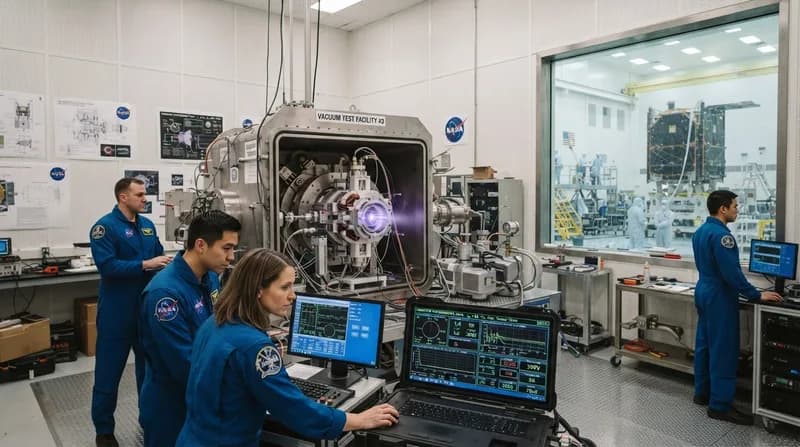
The Future of In-Space Maneuvering
In a bold move to modernize orbital logistics, NASA has announced the Advanced Mid-Power Electric Rocket (AMPERE) Challenge. This initiative aims to accelerate the maturation of electric propulsion systems by offering a total of $500,000 in prizes. By targeting the mid-power bracket—systems requiring between 3,000 and 7,000 watts of electricity—the space agency hopes to bridge the gap between experimental laboratory prototypes and flight-ready hardware.
Electric propulsion, specifically via Hall effect thrusters, is becoming the gold standard for long-term space missions. Unlike traditional chemical rockets that provide a massive, short-lived burst of speed, electric thrusters offer a steady, highly efficient burn over months or even years. This is essential for satellite station-keeping, deep-space robotic exploration, and complex orbital maneuvers that demand precision and fuel economy.
How Hall Effect Thrusters Work
The core of this challenge lies in the sophisticated physics of Hall effect thrusters. These engines operate by utilizing both electric and magnetic fields to ionize and accelerate an inert propellant gas, such as xenon or krypton, at extremely high velocities. By ionizing these particles, the engine generates thrust that, while lower in total force than a combustion engine, achieves significantly higher specific impulse—a measure of fuel efficiency.
Because these systems are so efficient, they allow for much lighter spacecraft designs, as engineers can significantly reduce the amount of onboard chemical propellant required. This weight reduction directly translates into lower launch costs or the ability to carry more scientific instrumentation. The AMPERE Challenge is specifically interested in the 3-7 kW range, which experts identify as the "sweet spot" for the next wave of commercial satellites and defense-oriented spacecraft.
Why it Matters: The Road to Commercialization
- Operational Longevity: Higher efficiency means spacecraft can remain operational in orbit for much longer durations, extending the return on investment for expensive satellite assets.
- Deep-Space Readiness: Enhanced thruster performance is critical for future missions that venture beyond Earth orbit, including missions to the Moon and Mars.
- Industry Partnership: By providing access to NASA testing facilities, the agency is actively reducing the barrier to entry for commercial aerospace firms looking to prove their hardware under extreme space-like conditions.
Participation and Project Goals
The competition is structured to foster collaboration between the public sector and private industry. Open to U.S.-based companies, the program spans three distinct phases, culminating in the selection of up to two winners who will each be eligible for $250,000 in prize money. Beyond the capital, the true value for many participants will be the technical feedback and verification provided by NASA’s world-class testing centers, which are essential for validating the performance and reliability of complex propulsion systems.
Registration for the AMPERE Challenge opened on November 9, 2026, and will conclude on January 27, 2027. Prospective companies are tasked with demonstrating that their prototypes can handle the rigors of spaceflight with predictable output. This rigorous vetting process is designed to ensure that when these thrusters eventually reach orbit, they are prepared to withstand the harsh, vacuum environment of space for years on end.
Outlook and Implications
As the commercial space sector grows, the demand for reliable, high-efficiency propulsion is skyrocketing. This challenge represents a strategic pivot for NASA, shifting from purely internal research toward a collaborative ecosystem where private companies are incentivized to solve critical engineering hurdles. If successful, the AMPERE Challenge will likely result in a new generation of standardized, highly capable propulsion modules that could define the architecture of our future space infrastructure, from lunar logistics networks to next-generation telecommunications constellations.