Revealing Order Within Cosmic Turbulence
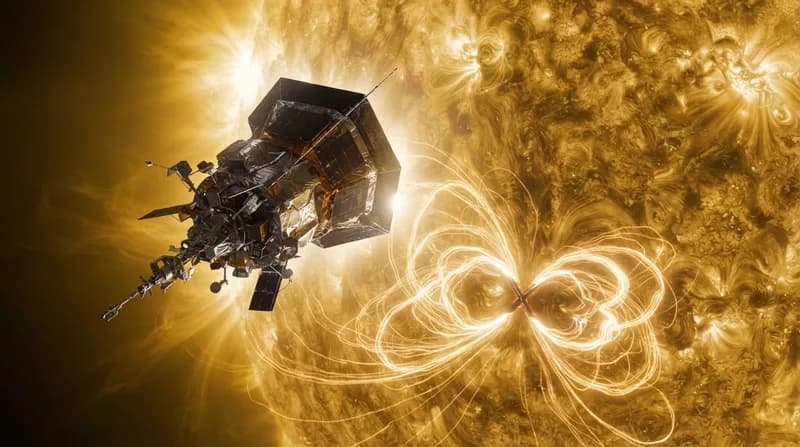
For decades, scientists have grappled with the erratic, swirling nature of turbulence in space. Unlike the fluid dynamics we observe in Earth's atmosphere or oceans, the plasma state of space—where particles are thinly spread and electrically charged—behaves with a complexity that has long defied standard physical models. Recent data from NASA’s Parker Solar Probe has finally pierced this veil of chaos, identifying a distinct, hidden pattern that governs how magnetic fields behave at the smallest scales.
An international team of researchers, led by the University of Tokyo and Technische Universität Braunschweig, published these findings in The Astrophysical Journal Letters. They discovered that magnetic fields within the solar wind do not simply fluctuate randomly; rather, they undergo a systematic reversal in their direction of rotation when observed at microscopic levels. This direct observation of magnetic helicity behavior marks a significant milestone in our understanding of space physics.
The Mechanism of Magnetic Reversal
The research team identified that, when viewed along the path outward from the Sun, magnetic fields typically exhibit a counterclockwise rotation at larger, fluid-like scales. However, as the scale of observation narrows to the point where plasma transitions from collective fluid movement into individual particle dynamics, a consistent 'flip' occurs, forcing the fields into a clockwise rotation.
This transition point is critical. As the solar wind moves further away from the Sun, this reversal phenomenon becomes more pronounced and migrates toward longer wavelengths. According to Dr. Masatomi Iizawa, the study’s lead author, identifying such a structured feature within otherwise unstructured motion is a breakthrough, providing a rare glimpse into the organized physics hidden beneath the surface of seemingly random solar activity.
Why It Matters: Forecasting Space Weather
Understanding this magnetic reversal is more than just a theoretical triumph; it has direct implications for our ability to monitor and predict space weather. Solar eruptions release clouds of magnetic material and shock waves that travel through interplanetary space, often impacting Earth's magnetosphere and disrupting satellite communications, GPS, and power grids.
- Enhanced Modeling: By pinpointing how organized patterns emerge from turbulent plasma, scientists can refine the physical models currently used to forecast geomagnetic storms.
- Energy Distribution: The study sheds light on how energy is distributed across different scales of plasma, a longstanding puzzle in astrophysics.
- Universal Application: Because this type of turbulence occurs throughout the universe—from planetary magnetospheres to the accretion disks surrounding distant stars—this discovery provides a universal framework for studying plasma physics in various astronomical environments.
As the Parker Solar Probe continues its daring dives into the solar environment, this discovery serves as a reminder of how much remains to be learned about the star that sustains our solar system. The shift from fluid-like behavior to kinetic particle dynamics, now evidenced by this magnetic flip, will likely become a cornerstone for future space weather research and astrophysical inquiry.