Scaling Multi-modal Architecture
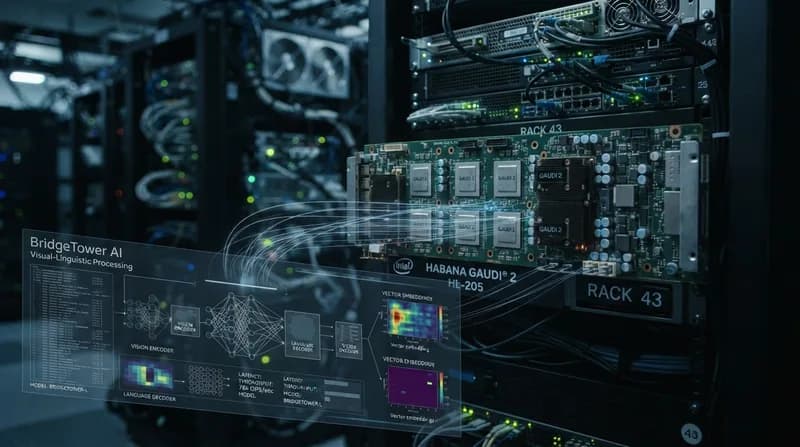
The convergence of visual and linguistic processing has reached a new performance tier with the optimization of the BridgeTower model architecture for Habana Gaudi2 accelerators. By bridging the gap between vision and language through a novel multi-modal framework, this initiative marks a pivotal shift in how researchers can handle complex data interactions more efficiently.
BridgeTower is specifically engineered to align cross-modal representations by implementing a series of bridge layers between the individual vision and language encoders. This design choice enables the model to learn sophisticated connections between pixels and tokens, resulting in a more robust understanding of image-text pairs compared to traditional architectures that often struggle with deep feature fusion.
Why it Matters
- Hardware Synergy: Leveraging Habana Gaudi2 accelerators allows for massive parallelization of training tasks, significantly reducing the temporal costs associated with large-scale vision-language model development.
- Enhanced Feature Fusion: The bridge modules facilitate early and mid-level feature fusion, which is crucial for tasks requiring high granularity in cross-modal retrieval and generative reasoning.
- Performance Optimization: By offloading computation to Gaudi2, developers can achieve superior throughput, making it feasible to iterate on model weights and hyper-parameters at a faster cadence than standard GPU configurations might permit.
The integration demonstrates the importance of matching sophisticated software architectures with specialized silicon. As AI models continue to expand in complexity, the ability to utilize purpose-built hardware like the Gaudi2 ecosystem will become a defining factor for laboratories looking to push the boundaries of multimodal learning. This advancement not only sets a new benchmark for BridgeTower's deployment potential but also provides a roadmap for researchers looking to optimize similar transformer-based architectures for high-demand AI workloads in the evolving hardware landscape.