ScienceTechnical Deep Dive

One Year on Mars: NASA’s CHAPEA Crew Completes Historic Isolation Mission

Published
EElectricBuzz Editorial Team
One Year on Mars: NASA’s CHAPEA Crew Completes Historic Isolation Mission
3 min read456 wordsElectricBuzz Editorial Team

The Gist

“Four NASA volunteers have concluded a year-long simulated Mars mission, providing critical data on human resilience and resource management for future deep-space exploration.”

The End of a Red Planet Simulation

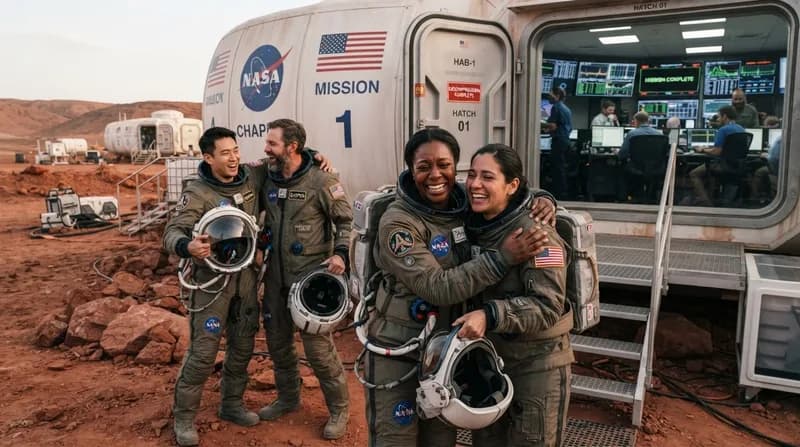
After more than 365 days of complete isolation, four NASA volunteers—Matthew Montgomery, James Spicer, Ross Elder, and Ellen Ellis—stepped out of their habitat on October 31, 2026, marking the successful conclusion of the Crew Health and Performance Exploration Analog (CHAPEA) mission. While the crew remained firmly rooted on Earth, their environment was meticulously engineered to replicate the punishing, resource-scarce conditions of a Martian outpost. This ambitious experiment serves as a cornerstone for NASA’s long-term strategy to send humans to the Red Planet, testing not only the hardware required for survival but also the psychological and physiological limits of the crew.

Simulating the Martian Frontier

The CHAPEA program was designed to mirror the daily grind of a future Mars colony. Throughout the year, the participants were tasked with the rigorous maintenance of mission-critical systems, the cultivation of supplemental crops, and the careful management of limited supplies. One of the most significant hurdles simulated was the inherent communication delay between Earth and Mars. Unlike missions to the International Space Station, where real-time support is available, these volunteers operated under a delay that forced them to function with high levels of autonomy. They were required to diagnose complex system failures and navigate unexpected emergencies without the immediate safety net of ground control, offering NASA invaluable data on human problem-solving under extreme pressure.

Why it matters: From Analog to Actual Deep Space

The data gathered from this mission is instrumental in refining the protocols for upcoming lunar and Martian expeditions. By studying how individuals cope with prolonged confinement, resource conservation, and high-stakes teamwork, NASA is better equipped to design habitats that sustain both physical health and psychological well-being. The findings from this year-long isolation will directly inform the infrastructure of planned lunar bases, which are considered the essential testing ground before attempting the multi-million-mile trek to Mars.

  • Mission Scope: 12 months of sustained isolation in a Mars-analog environment.
  • Key Focus Areas: Resource conservation, crop production, and system maintenance.
  • The Autonomy Challenge: Successfully testing operational procedures in the presence of simulated communication lag.
  • Broader Impact: Informing the design of future Artemis lunar habitats and long-duration space mission protocols.

Future Implications

As NASA shifts its focus toward the Artemis lunar missions and eventual crewed Mars expeditions, the importance of these analog studies cannot be overstated. The lessons extracted from Montgomery, Spicer, Elder, and Ellis provide a roadmap for the logistical complexities of life in deep space. By bridging the gap between theoretical models and real-world human performance, NASA is transforming the dream of planetary colonization into a series of achievable, evidence-based steps. This mission proves that while the challenges of the Red Planet are immense, human ingenuity remains our most reliable tool for overcoming them.


SPONSORED
The 5 Best Over-Ear ANC Headphones of 2026, Tested & Ranked
Editor's Pick Guide
92/100
Tech & Gadgets•12 min read

The 5 Best Over-Ear ANC Headphones of 2026, Tested & Ranked

We locked five over-ear ANC picks for 2026 — Sony WH-1000XM6, Bose QuietComfort Ultra 2, Soundcore Space One, Sennheiser Momentum 5, and Apple AirPods Max 2 — then stress-tested them on lab metrics, long-term owner truth, and live street prices.

Related Stories

Semantically matched articles, ranked by topic overlap and freshness.

Unlocking Nature’s Blueprint: How Simple Chemistry Dictates Hair Growth
Science

Unlocking Nature’s Blueprint: How Simple Chemistry Dictates Hair Growth

Researchers at the University of Geneva have discovered that complex hair follicle patterns arise from simple cellular signaling, potentially overturning decades of biological theory.

Unlocking the Mystery of Persistent Heart Disease Risks
Science

Unlocking the Mystery of Persistent Heart Disease Risks

New research from Chalmers University of Technology reveals why some patients remain at risk for heart attacks even when bad cholesterol levels are managed.

A Breakthrough in Diagnostics: Synthetic Probe Detects Heart Disease Without Cold Storage
Science

A Breakthrough in Diagnostics: Synthetic Probe Detects Heart Disease Without Cold Storage

Researchers have developed a robust, antibody-free diagnostic tool that identifies inflammatory heart disease biomarkers, potentially transforming point-of-care testing in underserved regions.

Could the 'Christchurch Mutation' Be the Key to Unlocking Parkinson's Treatments?
Science

Could the 'Christchurch Mutation' Be the Key to Unlocking Parkinson's Treatments?

New research suggests a rare genetic mutation previously linked to Alzheimer's resistance may also shield the brain from Parkinson's disease, opening doors for revolutionary gene therapies.

New Study Flags Potential Heart Risks in Energy Drinks and Stimulant Supplements
Science

New Study Flags Potential Heart Risks in Energy Drinks and Stimulant Supplements

Researchers have identified a significant spike in cardiac-related safety reports linked to high-caffeine energy drinks, particularly among younger demographics.

Prehistoric Giant: Fossil Discovery Reveals 66-Pound Rodent from 34 Million Years Ago
Science

Prehistoric Giant: Fossil Discovery Reveals 66-Pound Rodent from 34 Million Years Ago

Paleontologists have unearthed evidence of a massive ancient rodent in Thailand, challenging existing theories on the timeline and geography of rodent gigantism.

New Surgical Protocol: Skipping Morning Blood Pressure Medication Reduces Intraoperative Risks
Science

New Surgical Protocol: Skipping Morning Blood Pressure Medication Reduces Intraoperative Risks

A major clinical trial reveals that withholding ACE inhibitors and ARBs on the day of noncardiac surgery significantly lowers the risk of dangerous intraoperative hypotension in older patients.

Atmospheric Anomaly: Why the Antarctic Ozone Hole Expanded to a Decade-High
Science

Atmospheric Anomaly: Why the Antarctic Ozone Hole Expanded to a Decade-High

Despite a significant seasonal expansion in 2026, climate experts at NASA and NOAA emphasize that the long-term recovery of Earth's ozone layer remains firmly on track.