Stability Meets Precision
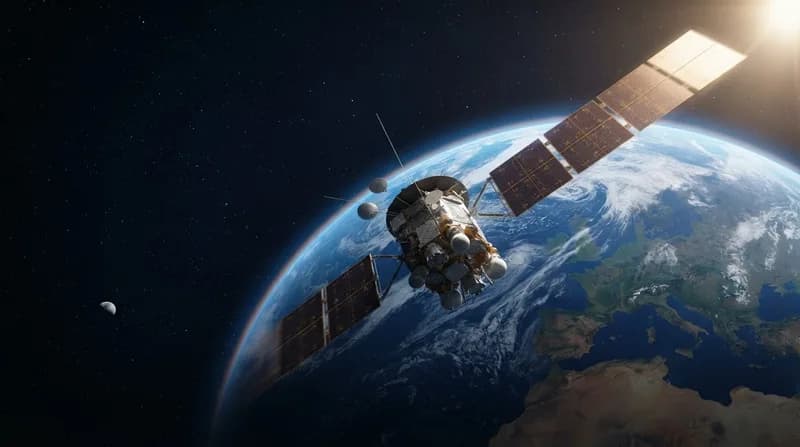
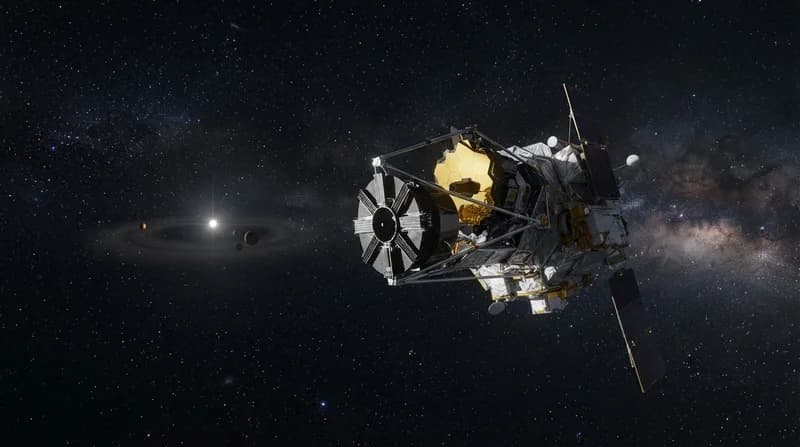
NASA has reached a critical milestone in the deployment of the Nancy Grace Roman Space Telescope, marking the successful demonstration of its high-precision pointing and stabilization systems. Between September 15 and September 21, engineers put the observatory's fine-guidance system to the test, confirming it can remain locked onto celestial targets with extraordinary stability. This capability is essential, as the mission requires the telescope to capture light over exposures lasting anywhere from minutes to several hours, where even a microscopic shift could blur the final data.
To achieve this, the telescope employs an attitude control system that processes data from its Wide Field Instrument's detectors. By monitoring known guide stars four times every second, the observatory can make real-time, infinitesimal adjustments to counteract any drift. The current level of stability is being compared to the feat of keeping a laser pointer focused on a U.S. dime from 150 miles away—a metric the team expects to improve significantly as the system continues to be calibrated.
The Coronagraph's First Light
Following the successful stability tests, NASA activated the telescope's Coronagraph Instrument on September 22. This specialized hardware is designed to suppress the overwhelming glare of a star, allowing the telescope to detect and study the much fainter light of orbiting planets and surrounding dusty disks. The coronagraph features its own internal stabilization process, which provides even greater accuracy than the primary Wide Field Instrument, a necessity for isolating the weak signals of distant worlds.
The initial commissioning of the coronagraph involved stretching its mechanical and electronic limbs before capturing preliminary images of stars in the Large Magellanic Cloud. While these early tests were conducted at warmer-than-optimal detector temperatures to prevent contamination, they served as a vital “proof of life” for the instrument. Subsequent testing, after cooling the detectors to improve sensitivity, successfully confirmed that the coronagraph can point to specific celestial coordinates and resolve multiple star clusters, signaling that the hardware is functioning as designed.
Innovating Space Guidance
Beyond its standard operating procedures, the Roman Space Telescope is slated to test an unprecedented guidance methodology. Unlike previous space-based observatories that relied on dedicated guider instruments, Roman will utilize "spectral guiding." By analyzing the wavelength patterns of light—known as spectra—that the telescope is already collecting for its primary scientific mission, engineers can use this data to calculate the observatory's orientation in real time.
This dual-purpose use of collected light represents a significant efficiency improvement in space mission architecture. By eliminating the need for a separate guider instrument, the mission simplifies its internal complexity while leveraging its primary scientific tools to ensure its own positional accuracy. The validation of this spectral guiding mode is expected to be a major focus of upcoming commissioning phases, providing a blueprint for future deep-space observatories that demand extreme pointing fidelity without adding excess weight or hardware constraints.