A New Standard in Orbital Transit
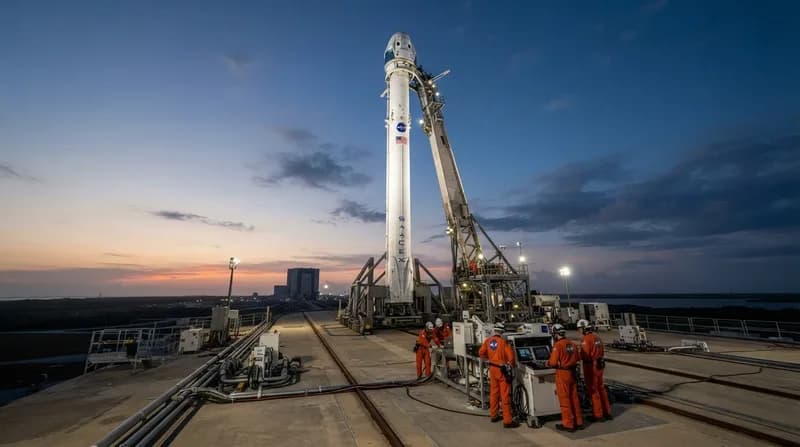
NASA and SpaceX are putting the finishing touches on the Crew-13 mission, an ambitious flight scheduled to launch from Cape Canaveral Space Force Station. The mission, slated for an October 1 liftoff, highlights the increasing precision of modern orbital rendezvous. If the schedule holds, the Dragon spacecraft will complete the journey from its launch pad in Florida to the International Space Station in under nine hours, a testament to the refined synchronization between the Falcon 9 launch vehicle and the Dragon's autonomous navigation systems.
The mission represents more than just a commute; it is a complex technical ballet. After the Falcon 9 clears the atmosphere and reaches orbit, the Dragon spacecraft must maneuver through a series of burns to close the distance to the orbiting laboratory. The final phase involves an autonomous approach to the Harmony module's forward-facing port, where the craft will execute a precise docking procedure. This rapid transit capability is critical for optimizing the time astronauts spend in the field rather than in transit, and it serves as a operational baseline for future deep-space logistics.
The Crew-13 Roster
The mission brings together an international team of four highly trained professionals, all of whom will join the ongoing Expedition 75 mission upon arrival. Their presence aboard the station is essential for maintaining the continuous scientific throughput that the ISS has become known for over the past two decades.
- Jessica Watkins (NASA): Serving as the spacecraft commander, Watkins leads the mission and holds primary responsibility for the safety of the crew and the success of the transit.
- Luke Delaney (NASA): As the pilot, Delaney will work closely with the Dragon’s automated systems, monitoring telemetry and flight dynamics during the high-speed approach to the station.
- Joshua Kutryk (CSA): Representing the Canadian Space Agency, Kutryk serves as a mission specialist, bringing specialized expertise to the scientific research agenda of Expedition 75.
- Sergey Teteryatnikov (Roscosmos): Rounding out the crew, the Russian cosmonaut joins as a mission specialist, reflecting the continued international collaboration required to operate and maintain the complex systems of the ISS.
Why It Matters
This mission underscores the reliability of the public-private partnership model that has revolutionized low-Earth orbit access. Beyond the impressive transit speed, the mission is a cornerstone of the broader Expedition 75 research program. The astronauts are slated to undertake a rigorous schedule of scientific experiments, station maintenance, and technology demonstrations. By keeping the crew rotation process efficient, NASA ensures that the "lab in the sky" remains fully staffed, allowing for a seamless transition as they take over the reins from the previous crew. This operational cadence is essential for testing the life-support and habitation technologies that will eventually be required for long-duration missions to the Moon and beyond.
Technical Outlook and Implications
While the transit time is a headline-grabbing figure, the underlying importance lies in the mission's readiness profile. Following a brief delay earlier this year due to propulsion system maintenance, the current flight readiness status indicates that SpaceX has successfully remediated previous hardware concerns. The quarantine phase at the Johnson Space Center remains a non-negotiable standard, highlighting the extreme health protocols required to protect the station's delicate environment from Earth-borne pathogens. As the October launch window approaches, the eyes of the aerospace community remain fixed on the efficiency of this nine-hour window, which may soon become the gold standard for orbital transport.