Tech & GadgetsTechnical Deep Dive

Microsoft Reveals Azure Maia 300: A Multi-Gigawatt Ambition for Agentic AI

Published
EElectricBuzz Editorial Team
Microsoft Reveals Azure Maia 300: A Multi-Gigawatt Ambition for Agentic AI
2 min read375 wordsElectricBuzz Editorial Team

The Gist

“Microsoft is scaling up its custom silicon strategy with the Maia 300, a high-performance accelerator system designed to dominate the next era of long-context AI inference.”

The Shift Toward Vertically Integrated AI

Microsoft has officially unveiled the successor to its custom AI silicon lineup, the Azure Maia 300. Marking a significant evolution in the company's infrastructure strategy, this new hardware is designed specifically to handle the complexities of modern agentic inference—a shift from simple generative tasks to multi-step, tool-using AI agents that demand much higher arithmetic intensity and memory bandwidth.

While Microsoft previously emphasized a strategy built on external partnerships, the introduction of the Maia 300 underscores a move toward full-stack vertical integration. By co-designing its silicon, physical rack architecture, networking, and datacenter software as a single cohesive unit, Microsoft aims to achieve performance levels that off-the-shelf GPU clusters struggle to reach in specific AI-heavy cloud workloads.

Technical Specifications and Performance Metrics

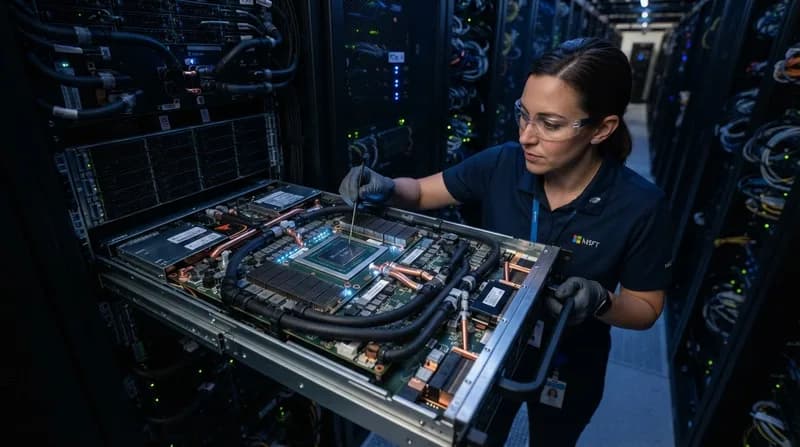
The Maia 300 is not merely an incremental improvement; it is a fundamental redesign optimized for decode-heavy and long-context AI processing. A single rack-scale configuration features 96 accelerators working in tandem, providing a massive boost to computational efficiency. According to early data, this 96-chip setup promises seven times the token throughput of the current Maia 200 system.

Key technical highlights include:

  • Architecture: Inference-first design optimized for high-memory intensity.
  • Memory: Each Maia 300 unit incorporates eight HBM4 memory stacks, delivering a peak memory bandwidth of up to 18 TB/s.
  • Efficiency: Microsoft claims the platform will deliver 40 percent more tokens per megawatt compared to industry-standard GPU systems.
  • Scalability: The hardware is designed for multi-gigawatt deployments, with widespread production expected to commence in 2027.

Why it Matters

The transition toward agentic AI changes the computational profile of data centers. Because these agents require long-context decoding and frequent interaction with external tools, they are significantly more memory-constrained than traditional LLMs. Microsoft’s move to build its own hardware, similar to the strategies employed by Google, allows the company to optimize its power consumption and latency precisely for the needs of its own MAI model family. With plans to expand to multi-gigawatt capacity by 2027, Microsoft is positioning itself to be less reliant on third-party hardware vendors for its core AI infrastructure, signaling a major shift in the competitive landscape of cloud computing.

Further details regarding the deployment timeline and ecosystem integration are expected to be unveiled at the upcoming Microsoft Ignite 2026 conference.

SPONSORED
The 5 Best Over-Ear ANC Headphones of 2026, Tested & Ranked
Editor's Pick Guide
92/100
Tech & Gadgets•12 min read

The 5 Best Over-Ear ANC Headphones of 2026, Tested & Ranked

We locked five over-ear ANC picks for 2026 — Sony WH-1000XM6, Bose QuietComfort Ultra 2, Soundcore Space One, Sennheiser Momentum 5, and Apple AirPods Max 2 — then stress-tested them on lab metrics, long-term owner truth, and live street prices.

Related Stories

Semantically matched articles, ranked by topic overlap and freshness.

NetBSD Finds Unexpected Growth as a Haven for AI-Free Software Development
Tech & Gadgets

NetBSD Finds Unexpected Growth as a Haven for AI-Free Software Development

While the mainstream Linux ecosystem embraces AI-driven workflows, NetBSD is seeing a surge in support and donations by doubling down on its commitment to human-written code.

The $100 Billion Space Economy: How SpaceX’s IPO Is Transforming Orbit
Tech & Gadgets

The $100 Billion Space Economy: How SpaceX’s IPO Is Transforming Orbit

The aerospace sector has reached a monumental milestone as public market momentum and surging demand drive annual investment toward $100 billion.

TFG London Joins Growing List of Retailers Hit by Cyberattacks
Tech & Gadgets

TFG London Joins Growing List of Retailers Hit by Cyberattacks

Major retail group TFG London, owner of Hobbs, Phase Eight, and Whistles, confirms a significant cybersecurity incident disrupting its IT infrastructure and customer orders.

Intel Connectivity Suite: The Hidden IPv6 Bug Impacting Windows Users
Tech & Gadgets

Intel Connectivity Suite: The Hidden IPv6 Bug Impacting Windows Users

A persistent networking glitch linked to Intel’s Connectivity Performance Suite is causing cryptic IPv6 connection resets, leaving users struggling with Microsoft 365 services.

Microsoft Exchange Admin Center Outage Highlights Lingering Deployment Risks
Tech & Gadgets

Microsoft Exchange Admin Center Outage Highlights Lingering Deployment Risks

A routine configuration change recently crippled the Exchange Admin Center, leaving IT administrators locked out and questioning the efficacy of Microsoft's deployment testing protocols.

The AI Divide: Why Half of America Is Rejecting Chatbots
Tech & Gadgets

The AI Divide: Why Half of America Is Rejecting Chatbots

New data from the Pew Research Center reveals that a majority of American adults remain unconvinced by AI chatbots, with apathy—not incompetence—serving as the primary barrier to adoption.

Tencent Bets Big on the Future with $5 Billion AI War Chest
Tech & Gadgets

Tencent Bets Big on the Future with $5 Billion AI War Chest

Tencent has launched a massive $5 billion bond sale as the tech giant accelerates its strategic push into artificial intelligence development.

AMD Debuts Helion Rack Architecture Designed for the Agentic AI Era
Tech & Gadgets

AMD Debuts Helion Rack Architecture Designed for the Agentic AI Era

AMD is targeting the next wave of autonomous AI with its new Helion rack-scale infrastructure, offering modular CPU and GPU configurations for agentic workflows.