The Engine Behind Dynamic Storytelling
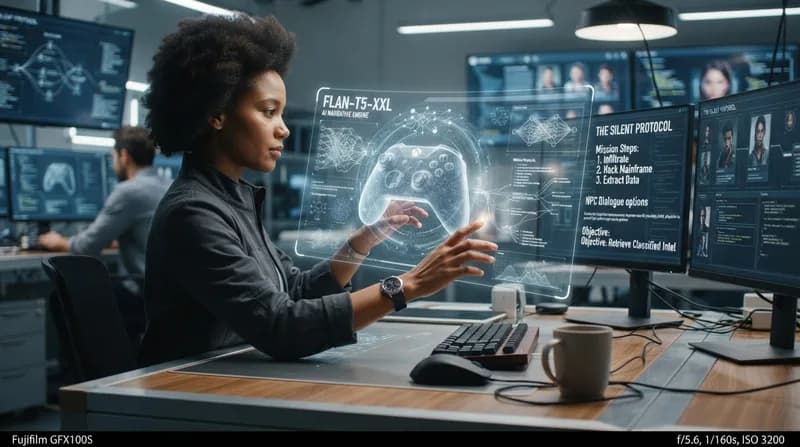
As the video game industry shifts toward increasingly expansive open-world environments, the demand for non-repetitive dialogue and quest content has skyrocketed. Addressing this bottleneck, developers are turning to large language models (LLMs) to serve as automated creative partners. At the forefront of this integration is Google’s Flan-T5-XXL, a robust 11-billion parameter model that has become a staple for developers aiming to proceduralize narrative complexity.
Unlike smaller models, Flan-T5-XXL excels at instruction-tuned tasks, making it particularly adept at following specific creative prompts such as 'write an NPC backstory in a Victorian horror setting' or 'generate a quest chain involving a lost artifact.' Because it is pre-trained on an extensive corpus of data, the model can maintain stylistic consistency, which is vital for preserving the 'voice' of a specific game world.
Why It Matters
- Scalability: By automating the drafting phase of dialogue trees, narrative designers can focus on high-level plot structure rather than line-by-line writing.
- Customization: The model can be fine-tuned on existing game scripts to mirror the specific tone, humor, or historical lexicon of a unique intellectual property.
- Efficiency: It significantly reduces the time-to-market for text-heavy RPGs by providing a baseline for world-building that human editors can then iterate upon.
The rise of these tools marks a pivotal moment for indie developers who may lack the resources for massive writing staffs. By utilizing open-source models like Flan-T5, teams can infuse their games with the depth of a triple-A title while maintaining a streamlined development pipeline. As the model continues to see updates and optimization, its role in game engines is expected to grow from a simple generation tool to a key component of real-time, responsive player interactions, where the story evolves dynamically based on user choices.