The Cybersecurity Arms Race
In an era where attackers are increasingly leveraging frontier AI to discover and exploit vulnerabilities at an unprecedented scale, the window for defenders is narrowing. Cybersecurity firm Sophos has taken a definitive step to reclaim that lead by integrating OpenAI Daybreak into its core infrastructure. By combining its own four decades of deep-rooted threat intelligence and domain expertise with OpenAI’s frontier models, Sophos is transforming how it protects more than 625,000 organizations globally.
This initiative is not merely about adding another layer of automation; it is about scaling the company’s vast security knowledge to support every customer simultaneously. Sophos’s CTO, John Peterson, emphasizes that while AI capabilities are spreading to bad actors, Sophos is using the Daybreak program to turn the tide, allowing the company to process, synthesize, and act upon threat data with a level of precision that was previously unattainable.
Inside the AI-Powered Defense Pipeline
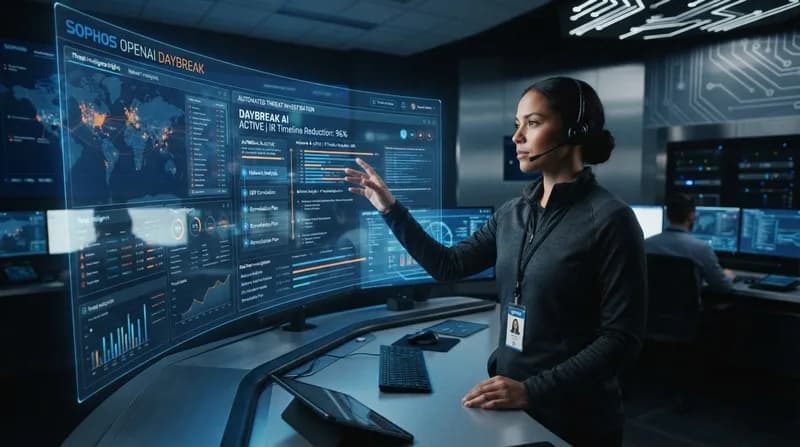
The heart of this transformation lies within Sophos Fusion, the company’s AI-native defense system. This platform acts as a central nervous system, pulling in telemetry from over 500 third-party integrations and Sophos’s proprietary security products. Each day, the system processes trillions of events, distilling them into roughly 1,000 to 2,000 actionable cases. Previously, these cases required intensive human manual investigation, a process that took an average of 38 minutes—an industry-leading time that Sophos has now completely shattered.
The new architecture employs specialized AI agents developed through the Daybreak program. An investigation agent is tasked with gathering customer-specific context, identifying Indicators of Compromise (IoCs), and pulling in relevant threat intelligence. A sophisticated planning model then initiates a continuous plan-execute-review loop. This agent-led workflow builds a comprehensive investigation roadmap, executes the necessary steps, and summarizes findings into actionable recommendations for analysts. The impact is quantifiable: the average response time has plummeted from 38 minutes to just 89 seconds, with 52% of all Managed Detection and Response (MDR) cases now handled entirely end-to-end by these autonomous agents.
Why It Matters: Human-Centric AI
- Efficiency Gains: Moving from 38 minutes to under 90 seconds represents a 96% reduction in investigation time, significantly lowering the risk of data breaches.
- Scalability: By automating over half of its case load, Sophos can scale its defenses without being constrained by the global shortage of skilled cybersecurity professionals.
- Strategic Focus: Analysts are freed from repetitive, low-level data gathering, allowing them to focus their human expertise on high-level strategy and complex, non-standard threats.
Maintaining the Human Element
Despite the rapid automation, Sophos has kept human judgment at the center of its operating model. The company offers three distinct service tiers—Notify, Collaborate, and Authorize—which determine the level of autonomy granted to its AI agents. In high-stakes scenarios or actions that could potentially disrupt business operations, the system is hard-coded to pause and await human validation.
This "human-in-the-loop" design ensures that while compute and intelligence are scaled to meet modern threats, the final decision-making power remains in the hands of security experts. As Sophos looks to the future, it plans to broaden the scope of these agents, increasing the sophistication of its automated response capabilities while maintaining a layered security posture that addresses the fundamentals of modern enterprise protection.