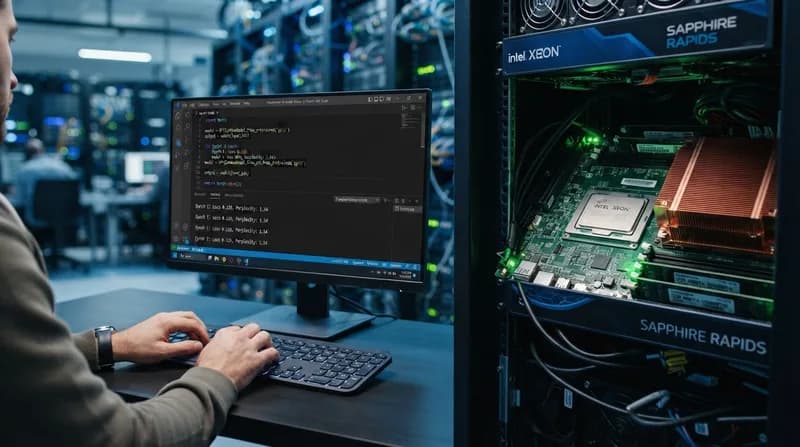
The Evolution of CPU-Based Inference
For many years, the standard path for deep learning inference has been the GPU. While graphical processors remain the gold standard for massive parallelism, the landscape is shifting as CPU architectures evolve to handle complex AI workloads. The introduction of Intel's fourth-generation Xeon processors—codenamed Sapphire Rapids—represents a major milestone in this transition. Featuring the new Advanced Matrix Extensions (AMX) instruction set, these chips are specifically designed to accelerate matrix multiplication, a fundamental operation in neural network processing.
By leveraging the Intel Extension for PyTorch (IPEX) and the Hugging Face Optimum Intel library, developers can now achieve performance gains that were previously exclusive to specialized hardware. This advancement effectively bridges the gap between general-purpose computing and dedicated acceleration, offering a more flexible and cost-effective route for organizations looking to scale their transformer-based NLP models without the inherent complexity of managing GPU clusters.
Hardware and Testing Methodology
To quantify these advancements, performance tests were conducted using Amazon EC2 instances to compare the latest Sapphire Rapids architecture against the previous generation, Ice Lake. Both the c6i.16xlarge (Ice Lake) and the r7iz.16xlarge-metal (Sapphire Rapids) configurations were equipped with 32 physical cores and 64 vCPUs, running on Ubuntu 22.04 with PyTorch 1.13. The goal was to establish a controlled environment where the only major variables were the processor architecture and the inclusion of the Optimum Intel library.
The benchmark suite focused on three popular NLP models: distilbert-base-uncased, bert-base-uncased, and roberta-base. The testing protocol simulated real-world scenarios by using both short 16-token sequences and longer, more complex sequences. To ensure accuracy, the team implemented a standard warmup phase followed by 1,000 inference iterations. On the Sapphire Rapids platform, the tests utilized bfloat16 precision and Just-In-Time (JIT) compilation, allowing the system to fully exploit the AMX instructions.
Performance Gains and Real-World Impact
The results underscore the efficacy of the new hardware-software stack. Specifically, for single prediction tasks using the distilbert-base-uncased model, the Sapphire Rapids architecture demonstrated a 60% to 65% improvement in speed compared to the Ice Lake generation. When combined with the optimizations provided by the Optimum pipeline, the overall performance leap allows developers to reach single-digit millisecond latency even for longer text inputs.
This level of performance effectively democratizes access to high-speed AI inference. By achieving near-GPU speed for transformer models on CPUs, businesses can significantly reduce infrastructure overhead. This flexibility is particularly beneficial for applications where low latency is required but the massive parallelism of a dedicated GPU setup might lead to underutilized hardware and unnecessary operational costs.
Why It Matters
- Cost Efficiency: CPU instances are generally more affordable and offer higher flexibility for scaling inference workers compared to GPU instances.
- Architecture Optimization: The AMX instruction set specifically targets deep learning bottlenecks, turning standard server CPUs into capable AI inference engines.
- Software Integration: The Hugging Face Optimum Intel library abstracts the complexity, allowing developers to implement these optimizations with only minor adjustments to existing PyTorch codebases.