The Philosophy Behind the Flat Organization
In a recent all-hands meeting that marked his return to the helm of the semiconductor giant, Nvidia CEO Jensen Huang addressed the elephant in the room regarding the company’s future leadership. Despite recent high-profile controversies that temporarily saw him step away, Huang reaffirmed his commitment to a business structure that defies traditional corporate orthodoxy. He explicitly dismissed the necessity of a formal succession plan, arguing that such measures introduce unnecessary, counterproductive layers of hierarchy into an organization designed for rapid innovation.
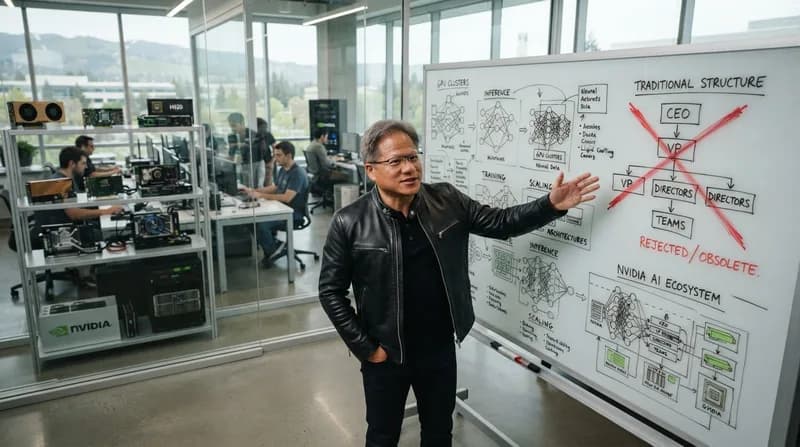
Huang’s management style has long been characterized by a remarkably flat structure. Unlike standard industry peers that rely on deep, bureaucratic reporting chains, Nvidia operates with a compact leadership team. Huang maintains a sprawling network of roughly 60 direct reports, supported by a core team of only four other executive officers. This includes CFO Colette Kress, who navigated the company through the interim period, as well as leads in operations, field service, and legal. For Huang, this configuration is not just a preference but a strategic necessity to ensure the company remains a nimble engine for product development.
Why it Matters
The debate over succession at Nvidia is more than just internal policy; it is a critical concern for investors who have watched the company become a central pillar of the global tech economy. Nvidia’s success is intrinsically tied to its unique organizational design, which Huang believes allows for faster communication and clearer focus on technical output. However, the absence of a clear transition path creates a narrative of instability that persists despite his recent return.
A Distinctive Corporate Blueprint
Huang has frequently argued that most companies suffer from standardized, copy-paste organizational charts that prioritize administrative convenience over product creation. In his view, a company should be engineered like a piece of high-performance machinery, specifically calibrated to produce its output. By stripping away middle management, he posits that Nvidia avoids the stagnation often found in larger, more rigid technology firms. Whether this lean, founder-centric model can withstand modern governance pressures remains a focal point for market analysts and shareholders who are increasingly wary of the risks associated with such a high degree of centralization.
Ultimately, while Huang remains steadfast in his commitment to this non-traditional structure, the pressure from institutional investors to provide a clear roadmap for the future is unlikely to dissipate. His vision for a resilient, flat organization is being tested by both the reality of a global enterprise and the scrutiny that follows a volatile period in the company’s recent history.