The Evolution of openEuler
For years, the landscape of enterprise Linux was dominated by Western-led distributions. However, at the most recent Open Source Summit Europe, a significant presence signaled a shift: openEuler, a project deeply connected to the Chinese tech sector, occupied the floor as a major player. Originally emerging from Huawei's EulerOS, openEuler has transitioned from a proprietary-leaning foundation into a community-driven project managed by the OpenAtom Foundation. With backing from tech giants including Alibaba, Baidu, Tencent, and Inspur, the platform is carving out a unique identity that extends well beyond its server roots.
The project’s history is inextricably linked to geopolitical shifts. Following US sanctions on Huawei in 2019 and the subsequent pivot of the CentOS project toward a stream-based model, Chinese vendors consolidated their efforts. Rather than merely cloning existing distributions, this coalition has prioritized homegrown innovation, creating a robust ecosystem that supports diverse CPU architectures, including x86-64, Arm, RISC-V, and LoongArch, as well as specialized chips like the SunWay RISC processors.
The Tech Stack and Developer Tools
The openEuler project distinguishes itself through a specialized suite of tools designed for modern enterprise demands. Central to this is the 'Intelligence BooM' stack, a collection of utilities specifically engineered to streamline the development, deployment, and management of Large Language Models (LLMs). This positions the distribution as a forward-looking platform for AI-heavy workflows.
Beyond AI, the project focuses on infrastructure flexibility and ease of transition. For system administrators looking to jump ship from legacy CentOS deployments, the project provides 'x2openEuler,' a dedicated migration tool designed to simplify the move to the new environment. The platform also boasts its own container engine dubbed 'iSula'—a play on the ant species—which offers a lightweight alternative for containerized workloads while maintaining support for industry standards like Kubernetes, Docker, and Podman.
DevStation: Bringing the OS to the Desktop
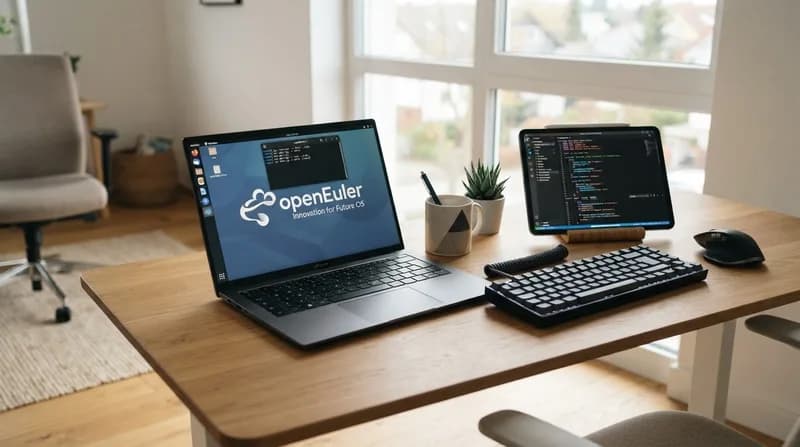
Perhaps the most intriguing development is the 'DevStation' edition, which targets workstation users. Booting into an environment powered by GNOME 49, the distro comes pre-configured with productivity-enhancing extensions like Dash to Panel and Arc Menu. While the default configuration reflects the project's roots with a preference for Simplified Chinese, it is easily localized for English-speaking users through standard system settings.
The desktop experience is remarkably modular. Users are not restricted to GNOME; the project offers a wide array of alternative desktop environments, including Deepin, UKUI, MATE, Xfce, and the Kiran Desktop Environment. Whether operating on Western x86 silicon or domestic Chinese CPUs like Phytium and Kunpeng, openEuler aims to provide a consistent, high-performance experience. By maintaining both a stable Long Term Support (LTS) track and a rapid-release innovation cycle, openEuler is positioning itself as a credible, sovereign-focused alternative for both the data center and the developer's desk.