Artificial IntelligenceTechnical Deep Dive

Industrial Next: The Startup Making Factory Robotics Agile Again

Published
EElectricBuzz Editorial Team
Industrial Next: The Startup Making Factory Robotics Agile Again
3 min read493 wordsElectricBuzz Editorial Team

The Gist

“Former Tesla engineers are tackling the static nature of factory floors by developing AI-powered robotic stations that can be retooled in minutes, not weeks.”

The End of Static Automation

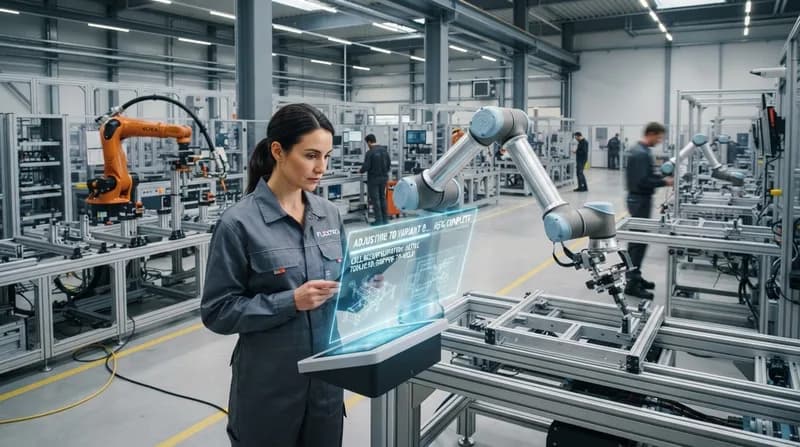
For decades, the factory floor has been governed by a rigid philosophy: once a robot is programmed for a task, it remains tied to that specific process until it is physically retooled, a process that can bleed productivity for weeks or even months. San Francisco-based startup Industrial Next is looking to shatter this status quo. By utilizing AI-driven, self-contained robotic stations powered by proprietary foundation models, the company is enabling manufacturers to switch tasks in mere minutes, effectively democratizing agile production at a scale previously reserved for the most sophisticated automotive giants.

The company, which recently stepped onto the Startup Battlefield stage at TechCrunch Disrupt 2026, aims to solve the persistent frustration that many manufacturing engineers face: the inability to apply modern software agility to aging, mechanical hardware. Industrial Next is bridging this divide by integrating vision, task context, and motion into a unified AI framework, allowing robots to perform delicate, complex maneuvers—such as connector assembly or protective film removal—with the speed and precision of a human worker, but with the tireless reliability of a machine.

The Secret Sauce: High-Fidelity Simulation

One of the primary challenges in training industrial robots is the distinct lack of massive, high-quality datasets that exist for other AI domains like large language models. Industrial Next circumvents this by relying on high-fidelity simulation engines. By creating a virtual world that mirrors real-world physics with surgical accuracy, their robots can "practice" complex, high-dexterity tasks in a simulated environment. This allows the machines to operate with extreme precision, often successfully manipulating components without the need to visually inspect them constantly.

The versatility of these systems is already being put to the test. Beyond generic manufacturing, Industrial Next's stations are currently being utilized in the production of flagship smartphones, handling tasks that were previously deemed impossible to automate successfully. The company is now eyeing an even more ambitious milestone: moving toward end-to-end car manufacturing where complex, multi-stage assemblies are managed entirely by their autonomous, reconfigurable cells, without the need for human intervention.

Why it Matters: The Evolution of the Factory

The manufacturing industry has long been hampered by outdated equipment that cannot easily adapt to changing product lines. Industrial Next’s approach is significant for three primary reasons:

  • Agility: Reducing retooling time from weeks to minutes minimizes downtime, allowing manufacturers to respond rapidly to market shifts.
  • Dexterity: The AI-first approach enables robots to handle delicate components and irregular tasks that once required human dexterity.
  • Scalability: By creating modular, self-contained units, companies can deploy and redeploy automation assets across various factory floors as needed, rather than committing to fixed, singular-use infrastructure.

Looking ahead, the company has announced a partnership with BMW Group Technology Office to further evaluate its AI-powered manipulation systems. Founded by Lukas Pankau and Allen Pan, two veterans of Tesla’s autonomous factory initiatives, Industrial Next is essentially attempting to build the "missing link" in industrial robotics: the ability to treat hardware with the same fluidity as software.


SPONSORED
The 5 Best Over-Ear ANC Headphones of 2026, Tested & Ranked
Editor's Pick Guide
92/100
Tech & Gadgets•12 min read

The 5 Best Over-Ear ANC Headphones of 2026, Tested & Ranked

We locked five over-ear ANC picks for 2026 — Sony WH-1000XM6, Bose QuietComfort Ultra 2, Soundcore Space One, Sennheiser Momentum 5, and Apple AirPods Max 2 — then stress-tested them on lab metrics, long-term owner truth, and live street prices.

Related Stories

Semantically matched articles, ranked by topic overlap and freshness.

Hugging Face and Microsoft Turbocharge AI Training with Optimum and ONNX Runtime
Artificial Intelligence

Hugging Face and Microsoft Turbocharge AI Training with Optimum and ONNX Runtime

A collaborative breakthrough between Hugging Face and Microsoft allows developers to slash training times for large language and vision models by over 130%.

The Rise of the Home AI Appliance: Cerebras CEO Predicts a New Era
Artificial Intelligence

The Rise of the Home AI Appliance: Cerebras CEO Predicts a New Era

Cerebras Systems CEO Andrew Feldman envisions a future where powerful local AI hardware becomes a staple in every household, blending on-device security with cloud-based intelligence.

Flox Intelligence: Bringing Nature-Aware AI to Global Infrastructure
Artificial Intelligence

Flox Intelligence: Bringing Nature-Aware AI to Global Infrastructure

Flox Intelligence is deploying edge-based AI hardware to intelligently deter wildlife from critical infrastructure, aiming to reduce costly accidents and environmental impact.

Court Mandates OpenAI to Hand Over Hiring Documents in High-Stakes Apple Litigation
Artificial Intelligence

Court Mandates OpenAI to Hand Over Hiring Documents in High-Stakes Apple Litigation

A federal judge has granted Apple expedited discovery into OpenAI’s recruitment records as the legal battle over alleged trade secret misappropriation intensifies.

Science Corporation Takes Major Step in Vision Restoration for Stargardt Disease
Artificial Intelligence

Science Corporation Takes Major Step in Vision Restoration for Stargardt Disease

Science Corporation has successfully implanted its PRIMA vision-restoring chip in a patient with Stargardt disease, marking a milestone in brain-computer interface technology.

Leveling Up Game Design: How Dreambooth is Revolutionizing 2D Asset Creation
Artificial Intelligence

Leveling Up Game Design: How Dreambooth is Revolutionizing 2D Asset Creation

New AI-driven breakthroughs are transforming how developers create 2D game assets, turning custom model training into a streamlined workflow.

Google Play Transforms: From App Store to Personal Creation Hub
Artificial Intelligence

Google Play Transforms: From App Store to Personal Creation Hub

Google is redefining the Android experience by allowing users to deploy private, AI-generated 'vibe-coded' apps directly to their phones without needing a public Play Store launch.

LiquidAI Unveils LFM 2.5-24B: High-Performance AI for On-Device Privacy
Artificial Intelligence

LiquidAI Unveils LFM 2.5-24B: High-Performance AI for On-Device Privacy

LiquidAI’s latest 24B parameter model brings powerful, private, and localized artificial intelligence capabilities directly to hardware.