A Historical Anchor for Modern Science
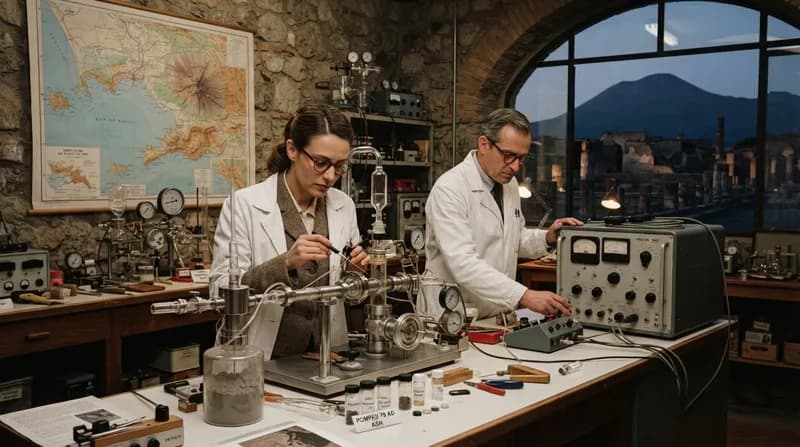
For nearly two millennia, the tragic account of Mount Vesuvius’ eruption in 79 CE, documented by Pliny the Younger, has served as a touchstone for historians. Now, researchers have transformed this ancient disaster into a cornerstone of modern geology. By utilizing the historical precision of the Pompeii eruption, a team from the Berkeley Geochronology Center, UC Berkeley, and the University of Padua has successfully recalibrated one of the most vital tools in geochronology: the argon-argon dating method.
The study, published in Science Advances, demonstrates that the eruption of Vesuvius provides an unparalleled benchmark. By analyzing sanidine—a potassium-rich volcanic mineral found in the pumice from that era—scientists have sharpened the accuracy and precision of their measurements. This advancement allows geologists to establish a much clearer timeline for major Earth events, ranging from ancient volcanic activity to massive extinction periods that defined the planet’s biological evolution.
Refining the Radioactive Clock
Argon-argon dating relies on the predictable radioactive decay of potassium-40 into argon-40. To improve this process, the research team focused on two key variables: the sample quality and the physical constants used in the calculation. By accessing high-potassium pumice samples collected decades ago from Oplontis, an area buried by the same eruption as Pompeii, researchers were able to secure material that represented the earliest phase of the eruption’s magma flow. This early material is crucial because potassium-rich magma typically sits at the top of a chamber and is expelled first, providing the cleanest, most reliable signatures for analysis.
The impact of this work on the scientific community is significant, particularly regarding the half-life of potassium-40, which is now measured with twice the precision of previous standards. By reconciling this with Bayesian statistical models, the team has successfully bridged the gap between argon-argon dating and other key methods, such as uranium-lead and radiocarbon dating. This unification of methodologies ensures that whether researchers are studying rock formations from billions of years ago or organic material from the last 50,000 years, they are working from a more consistent, unified temporal framework.
Why It Matters
- Enhanced Geological Causality: Improved precision allows scientists to better link seemingly disparate events, such as connecting specific meteor impacts to subsequent volcanic surges and mass extinctions.
- Risk Mitigation: More accurate dating helps experts better understand the eruptive history of high-risk active volcanoes, such as those near Naples, Mexico City, and Yogyakarta.
- Unified Geochronology: The research represents a major step toward standardizing the various radioactive “clocks” used in science, reducing conflicting results between different testing methods.
- Decadal Accuracy: The technique has now reached a level of precision that allows for decade-by-decade resolution for events within human recorded history.
The Future of Geological Chronology
This breakthrough is more than just a refinement of laboratory techniques; it is a fundamental shift in how we interpret Earth’s past. As team lead Paul Renne noted, the ability to achieve such high accuracy within the historical realm allows researchers to move from vague estimates to precise, reliable timelines. By utilizing the tragic, documented history of Pompeii to fine-tune our measurements of atomic decay, scientists are essentially building a more accurate clock for the history of the world itself. This new standard ensures that future investigations into the Earth's deep history will be grounded in a more consistent and verifiable reality.