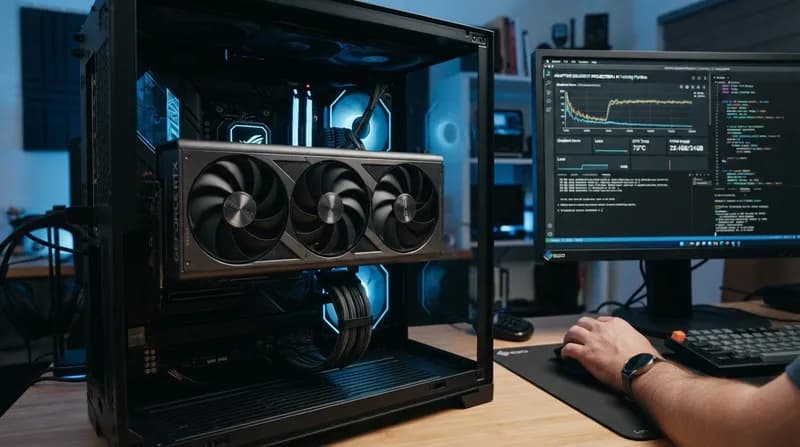
Democratizing Large-Scale AI Training
The barrier to entry for training Large Language Models (LLMs) has historically been defined by the sheer scale of high-end hardware required. Traditionally, training models with billions of parameters demanded enterprise-grade GPU clusters, effectively walling off significant AI research from those without deep pockets or massive data center access. The introduction of GaLore (Gradient Low-Rank Projection) changes that calculus entirely, enabling the training of models like Llama architectures on high-end consumer hardware such as the NVIDIA RTX 4090.
By fundamentally rethinking how gradients are stored and processed, GaLore allows developers to sidestep the massive memory bottlenecks typically associated with optimizer states. This development serves as a catalyst for democratizing AI, moving sophisticated model training from the domain of monolithic labs into the hands of independent researchers and practitioners.
The Mechanics of Memory Efficiency
At the core of GaLore's effectiveness is the strategic reduction of the memory footprint associated with optimizer states. Adaptive optimizers like Adam are famously memory-hungry, storing significant amounts of data during the backpropagation process. GaLore mitigates this by projecting gradients into a lower-dimensional subspace before they reach the optimizer. This mathematical trick dramatically reduces the dimensionality of the data requiring storage, resulting in a reported memory footprint reduction of over 82.5% for optimizer states during the training cycle.
To prevent the model from becoming trapped in a narrow optimization path, GaLore employs a dynamic subspace switching mechanism. This allows the model to periodically shift through different low-rank projections, ensuring the training process remains robust and capable of full-parameter learning. By balancing the frequency of these shifts, developers can maintain a consistent trajectory while effectively navigating the memory-optimization trade-off.
Synergy with 8-bit Optimization
GaLore gains even more potency when paired with 8-bit precision optimizers. This combination leverages quantization to further compress optimizer states, gradients, and model weights from standard 32-bit floating-point formats into 8-bit integers. While the core GaLore projection handles the dimensionality, the 8-bit integration handles the precision density, creating a highly efficient pipeline that maximizes the utility of limited VRAM.
The integration involves a multi-step process: gradient projection, quantization, optimizer updating, and de-quantization. During this workflow, GaLore ensures that the de-quantized updates are projected back into the original space before weight adjustments occur. This ensures that while the memory consumption is drastically lower, the mathematical integrity and convergence speed of the model remain largely intact.
Why it Matters
- Hardware Accessibility: Enables 7B+ parameter model training on single consumer-grade GPUs.
- Substantial Savings: Achieves an 82.5% reduction in memory for optimizer states.
- Seamless Integration: Fully supported within the Hugging Face Transformers library, allowing for easy adoption via simple flag updates in TrainingArguments.
- Flexible Optimization: Offers layer-wise update features that can further optimize memory usage for specific architectural needs.
Implementation for Practitioners
For developers looking to integrate this into their existing workflows, the process is streamlined through the Hugging Face ecosystem. By installing the `galore-torch` library and using compatible versions of `transformers` (v4.39.0 or later), users can simply specify `galore_adamw` or `galore_adamw_8bit` in their `TrainingArguments`. This design ensures that the transition to more memory-efficient training is a matter of configuration rather than a complete overhaul of existing codebases, marking a major milestone for AI accessibility.