Charging Revenue and Operational Growth
Fastned has reported a powerful third quarter for 2026, underscored by a substantial 47 percent year-on-year increase in adjusted charging revenue, reaching €46.3 million. Even when accounting for administrative delays in government e-credits, the company's core operations remain on a steep upward trajectory. This financial success is mirrored by a 44 percent surge in gross profit, which climbed to €37 million. The data suggests that consumer reliance on the network is hitting its stride, as organic charging volume grew by 27 percent, a figure that tracks closely with the expansion rate of battery-electric vehicle adoption in the regions where Fastned operates.
Efficiency metrics are equally promising. The company’s annualised average energy volume per station has hit 596 MWh, while revenue per location continues to track at the high end of their annual guidance—targeting between €350,000 and €400,000. These figures, bolstered by significant holiday traffic, highlight the success of Fastned’s strategic placement of high-speed charging infrastructure in high-traffic corridors.
Accelerating Infrastructure Development
The company’s physical presence is expanding at a record pace. With 17 new stations coming online in the third quarter alone and another 65 currently under active construction, Fastned is effectively doubling its development pipeline compared to the previous year. This rapid deployment is critical to their goal of managing 476 to 506 total locations by the end of 2026. Beyond sheer numbers, the quality of these sites is improving; for instance, the new facility at Libin Galaxia in Belgium now offers twelve charging points with power outputs reaching up to 400 kW, catering to the latest generation of ultra-fast charging EVs.
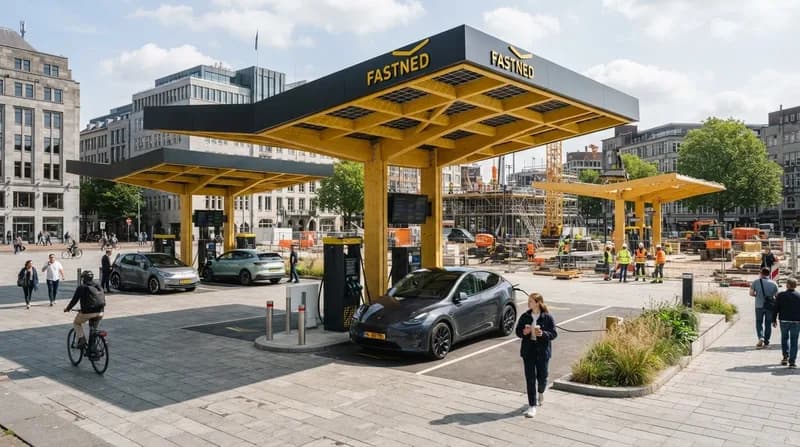
Strategic partnerships are also playing a pivotal role in boosting utilization. By integrating with large mobility networks, such as the ANWB Charge Card in the Netherlands, Fastned is gaining direct exposure to over 600,000 potential users. Furthermore, participation in government-backed initiatives like the Deutschlandnetz program in Germany is allowing the firm to secure premium locations along major transport arteries, ensuring that their branded solar-canopy stations remain a fixture for long-distance commuters.
The Cost of Scaling
While the operational outlook is bright, Fastned’s business model remains exceptionally capital-intensive. The company’s total liabilities have risen to over €514 million, reflecting the high costs of grid connections, transformer technology, and hardware. With the average cost to bring a single station to market hovering around €892,000, Fastned continues to rely on a strategy of debt financing, including successful retail bond issuances. Investors are closely watching how these investments convert into long-term profitability as the company aims to sustain an operating EBITDA margin of approximately 45 percent. The balance between aggressive growth and financial sustainability remains the primary focus for the company as it navigates this high-investment phase of the European energy transition.
Why it Matters
- Infrastructure Density: The increase in construction velocity directly addresses range anxiety, a critical barrier for mass EV market penetration.
- Financial Maturity: Despite high debt levels, the double-digit percentage growth in gross profit proves that the demand for high-speed charging is scaling with the vehicle fleet.
- Strategic Positioning: By securing tenders like Deutschlandnetz, Fastned is essentially "locking in" prime real estate that will serve as the backbone of European road travel for decades to come.