ScienceTechnical Deep Dive

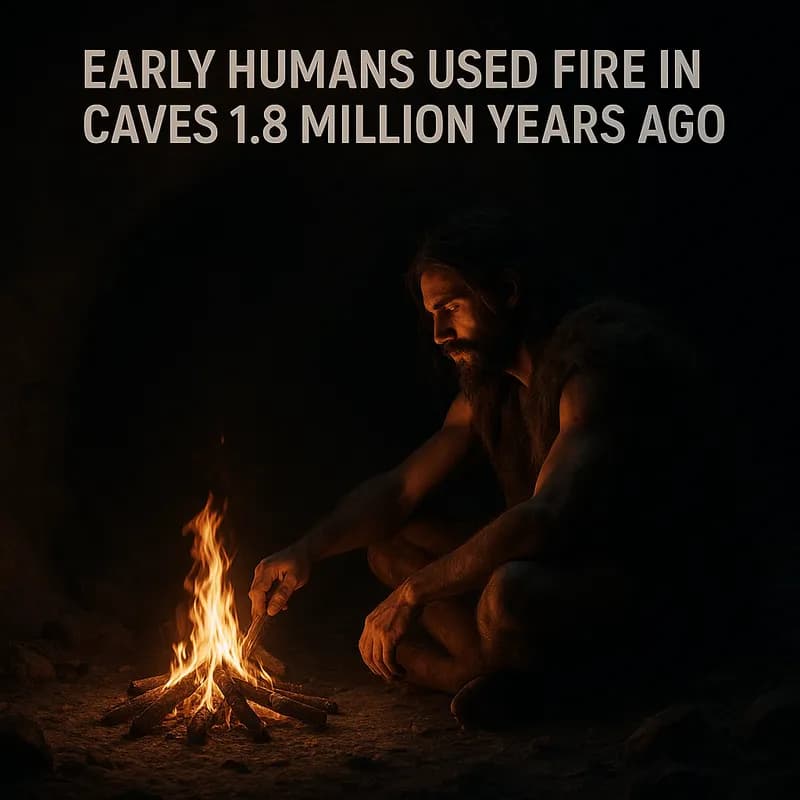
Early Humans Used Fire in Caves 1.8 Million Years Ago

Published
EElectricBuzz Editorial Team
Early Humans Used Fire in Caves 1.8 Million Years Ago
1 min read72 wordsElectricBuzz Editorial Team

The Gist

“Research from Wonderwerk Cave in South Africa shows early humans controlled fire deep inside caves 1.79 million years ago, indicating advanced fire use before they could create it on demand.”

Recent findings from Wonderwerk Cave in South Africa reveal evidence of burned bones dating back 1.79 million years. The bones were discovered deep inside the cave, in areas unreachable by natural wildfires, suggesting early humans brought and maintained fire in these sheltered environments.

This evidence points to sophisticated fire control capabilities of human ancestors long before they mastered fire creation techniques. The use of fire inside caves implies advanced behavior and adaptation.


SPONSORED
The 5 Best Over-Ear ANC Headphones of 2026, Tested & Ranked
Editor's Pick Guide
92/100
Tech & Gadgets•12 min read

The 5 Best Over-Ear ANC Headphones of 2026, Tested & Ranked

We locked five over-ear ANC picks for 2026 — Sony WH-1000XM6, Bose QuietComfort Ultra 2, Soundcore Space One, Sennheiser Momentum 5, and Apple AirPods Max 2 — then stress-tested them on lab metrics, long-term owner truth, and live street prices.

Related Stories

Semantically matched articles, ranked by topic overlap and freshness.

The Science of Stride: Why Shared Exercise Might Be Your Relationship’s Secret Weapon
Science

The Science of Stride: Why Shared Exercise Might Be Your Relationship’s Secret Weapon

New research from BYU reveals that couples who exercise together report better communication and lower stress, suggesting that a simple walk could be more than just a workout.

Could Japanese Cypress Roots Be the Future of Sleep Science?
Science

Could Japanese Cypress Roots Be the Future of Sleep Science?

New research from Kyushu University suggests that a discarded forestry byproduct may hold the key to deeper, more restorative rest.

Quantum Art: Visualizing Schrödinger's Legacy in Motion
Science

Quantum Art: Visualizing Schrödinger's Legacy in Motion

To celebrate the centennial of the Schrödinger equation, artist Gregor Harvie has unveiled a kinetic installation that bridges the gap between complex quantum theory and tangible physics.

New Study Highlights Urgent Need to Address Childhood Malaria in Sierra Leone
Science

New Study Highlights Urgent Need to Address Childhood Malaria in Sierra Leone

A landmark prospective study reveals that malaria remains the primary driver of infant mortality in Sierra Leone, despite ongoing public health vaccination efforts.

T-Cell Breakthrough: Decoding the Immune Response for Future-Proof Vaccines
Science

T-Cell Breakthrough: Decoding the Immune Response for Future-Proof Vaccines

New research into CD8+ T-cell activity reveals why some patients suffer severe COVID-19 while others recover easily, paving the way for vaccines that remain effective against evolving viral variants.

Unlocking the Shield: A New Strategy to Tackle Metastatic Colorectal Cancer
Science

Unlocking the Shield: A New Strategy to Tackle Metastatic Colorectal Cancer

Researchers have debunked a decades-old cancer theory, identifying a biochemical barrier that shields tumors from the immune system and revealing a potential path for breakthrough treatments.

Could Virtual Reality Be the Secret to Preventing Postpartum Depression?
Science

Could Virtual Reality Be the Secret to Preventing Postpartum Depression?

New research suggests that prenatal VR training sessions may significantly reduce the risk of postpartum depression, particularly for women who have previously given birth.

Cosmic Spectacles: The Four Must-See Celestial Events of October
Science

Cosmic Spectacles: The Four Must-See Celestial Events of October

From the vanishing act of Jupiter to the debris of Halley’s Comet lighting up the night, NASA outlines a packed schedule for October stargazing.