A Century of Quantum Mechanics
For one hundred years, Erwin Schrödinger’s wave equation has served as the bedrock of quantum mechanics, describing the probabilistic nature of the subatomic world. To commemorate this monumental anniversary, Scottish artist and researcher Gregor Harvie has unveiled a kinetic installation titled Superposition. Developed in partnership with the quantum theory group at the University of Glasgow, the work aims to distill abstract physical concepts into a visceral, experiential format.
The installation, hosted at the University of Strathclyde, transcends traditional sculpture. It challenges the viewer’s perception of reality by physically manifesting the elusive behaviors of superposition and entanglement. By moving away from mathematical abstraction, the project invites the public to engage directly with the “strangeness” that defines our understanding of the universe at its most fundamental level.
The Mechanics of Superposition
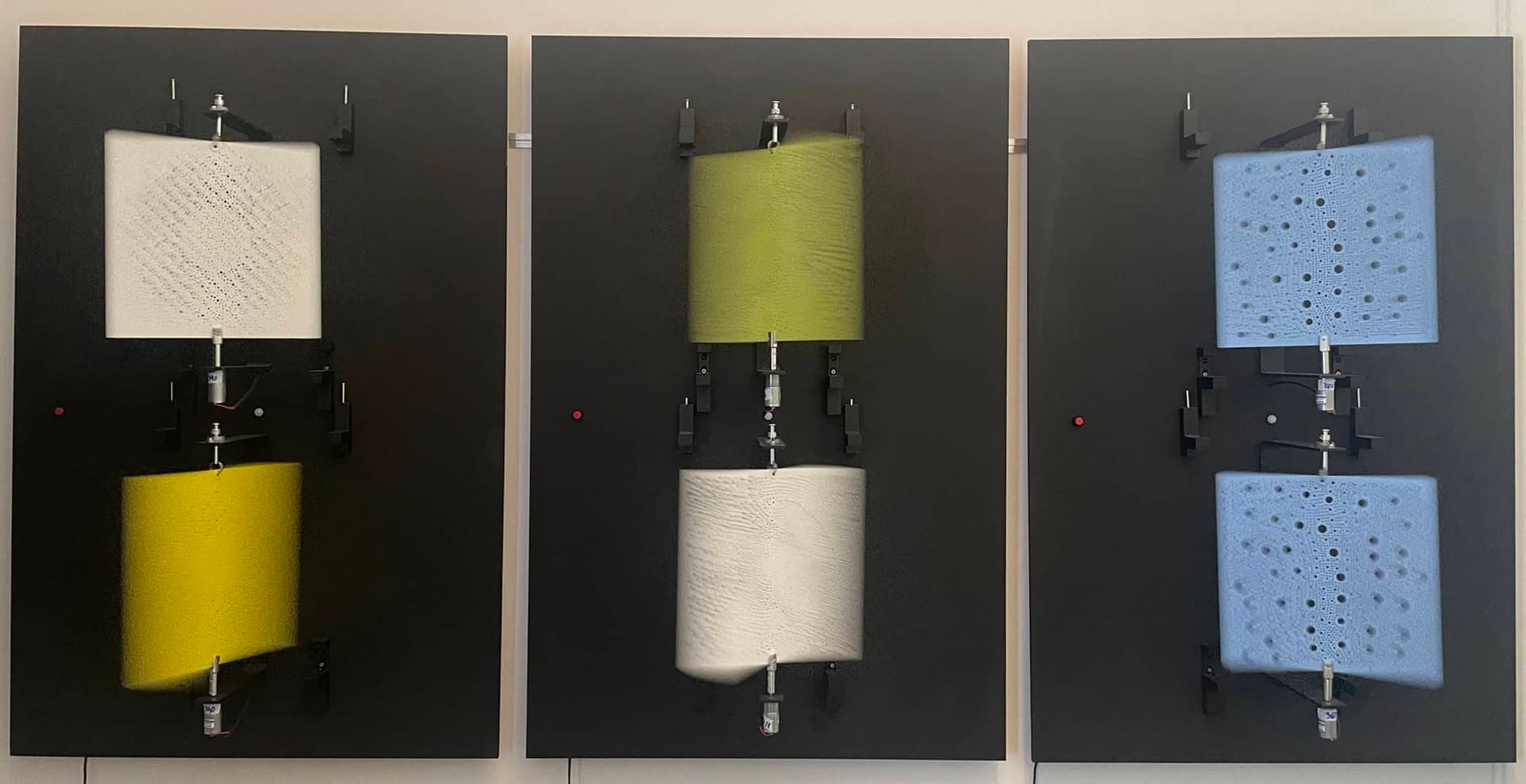
The core of the installation consists of 16 precision-engineered aluminium panels, each perforated with hundreds of intricate holes. These panels are arranged in eight distinct pairs. When stationary, the panels present a high-contrast aesthetic with one white side and one colored face. However, the installation comes to life when the panels begin to rotate at 400 rpm, causing their solid forms to dissolve into shifting, three-dimensional visual illusions that seem to defy the observer’s ability to focus.
This kinetic display serves as a direct metaphor for the collapse of the wave function. The panels spin randomly, and when they stop, they represent the measurement of a system. For seven of the pairs, the random stopping positions result in the panels matching their partners only half the time—a clear, visual representation of standard superposition in a binary state.
Entanglement and the Eighth Pair
The most compelling aspect of the artwork is the inclusion of a singular, distinct pair that behaves differently from the rest. While each panel within this eighth pair appears to stop at a random position when viewed in isolation, the collective behavior reveals a deeper connection. When observed together, these two panels match their orientation three-quarters of the time, acting as a physical analogy for quantum entanglement.
This deviation from the expected "random" probability illustrates the non-local correlations that characterize entanglement. As theoretical physicist Stephen Barnett notes, the installation pushes the audience to question their own observation process. By witnessing this anomalous behavior, the viewer is forced to confront the fact that reality, at the quantum level, does not operate under the intuitive logic of the macroscopic world.
Why It Matters
- Bridging Disciplines: The project highlights the growing trend of STEAM (Science, Technology, Engineering, Art, and Math) collaboration, using artistic intuition to explain high-level scientific breakthroughs.
- Public Understanding: By turning the Schrödinger equation into a kinetic display, the installation makes the abstract concept of "quantum strangeness" accessible to those without a physics background.
- Technical Innovation: Harvie, who holds a PhD in computational fluid dynamics, utilizes physical motion to simulate complex wave patterns that are usually relegated to computer models.
The Superposition installation remains open to the public at the University of Strathclyde’s Technology and Innovation Centre through October 29. It offers a rare opportunity to see the invisible laws of nature spun into motion, reminding us that even a century later, the quantum universe remains as mysterious as it is foundational.