The Philosophy of the Non-Robotics Robotics Company
The robotics industry is currently locked in a race to build the perfect mechanical form factor—humanoids with dexterous hands, quadrupedal runners, and specialized grippers. Destro AI, which recently emerged from stealth with an $8 million seed round, is betting that this focus on hardware is fundamentally backwards. By positioning itself as a software-first orchestration layer rather than a hardware manufacturer, Destro aims to bridge the gap between autonomous machinery and the human staff working alongside them in complex logistics environments.
Founder Manthan Pawar, a veteran in the U.S. supply chain sector, argues that the most significant hurdle in modern warehousing isn't a lack of cool hardware, but a lack of intelligent management. While competitors scramble to perfect robotic dexterity, Destro focuses on creating a sophisticated AI 'harness'—an operating system capable of directing both robots and human workers simultaneously. This approach allows the company to integrate into existing supply chain workflows without the need for a total facility overhaul.
The 'Mothership' OS and Cross-Docking Efficiency
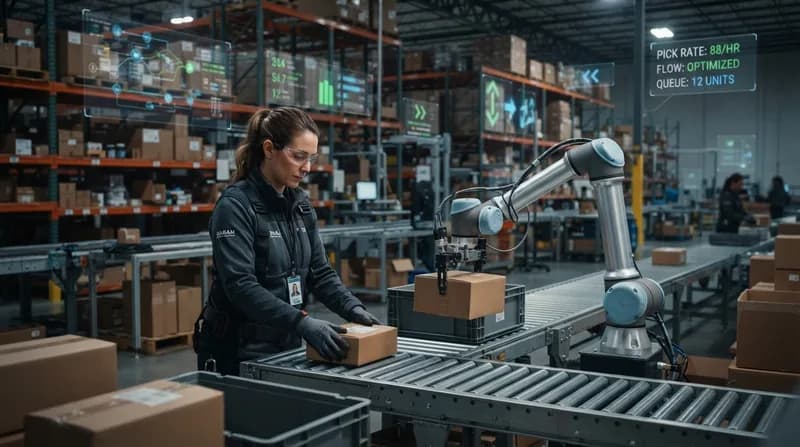
At the heart of Destro’s technology is the 'Mothership' operating system, a platform that utilizes open-weight vision-language-action models. These AI systems allow the software to interpret camera imagery, understand warehouse directives, and relay precise instructions to both robotic fleets and human personnel. In a typical cross-docking scenario, the software guides human workers through the unloading process, while simultaneously coordinating with autonomous robots that transport goods from the loading bay to their final staging areas.
This methodology has already been validated in real-world scenarios through a partnership with Yusen Logistics. In a Pacific Northwest facility, Destro successfully replaced manual, paper-based tracking with a systematic, AI-driven process using cart-moving robots. By directing the human, the cart, and the vehicle loading queue, the platform creates a cohesive flow that traditional robotic systems, which often lack the ability to manage human-robot interaction, simply cannot replicate.
Why it Matters
- Beyond Hardware: By remaining hardware-agnostic, Destro can adopt the best robotic platforms as they evolve without being tied to a single manufacturing lifecycle.
- Human-Robot Collaboration: The system is designed to complement human labor rather than replace it, using AI to reduce manual complexity and error rates in high-stakes logistics.
- Scalability: The platform is designed for a 'copy-paste' deployment, allowing it to scale rapidly across thousands of similar warehouse facilities that handle complex sorting and shipping tasks.
The Future of Warehouse Orchestration
As the company moves into a full deployment phase, including a 26-robot fleet and a new pilot program in Southern California, the challenge remains in scaling to tasks that require high-level manual dexterity. While general-purpose humanoids remain an industry fascination, Destro’s leadership remains skeptical of their current utility in real-world operations. For now, the company is doubling down on the belief that immediate operational efficiency comes from superior workflow management.
By securing backing from investors like Base10 Partners and Bonfire Ventures, Destro is signaling that the 'robotics' industry is shifting toward intelligence layers. As research continues to pump capital into foundation models and sophisticated robotic components, Destro’s strategy of building a harness around those platforms appears to be a calculated, high-value move that could define how we think about automation in the next decade of supply chain management.