ScienceTechnical Deep Dive

Deep-Sea Microbial Enzyme Defies Physics to Revolutionize Nitrogen Fixation

Published
EElectricBuzz Editorial Team
Deep-Sea Microbial Enzyme Defies Physics to Revolutionize Nitrogen Fixation
3 min read490 wordsElectricBuzz Editorial Team

The Gist

Researchers have discovered a heat-resistant enzyme in a deep-sea archaeon that operates at extreme temperatures, potentially paving the way for cleaner, sustainable fertilizer production.

A Masterclass in Extreme Biology

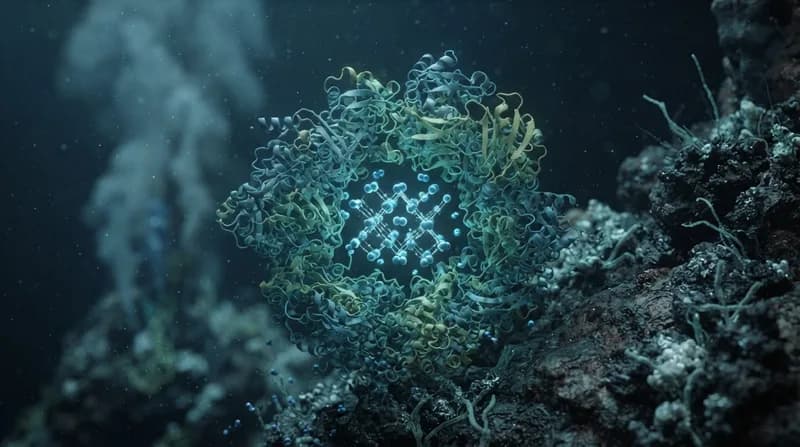
In the blistering, high-pressure environments of volcanic deep-sea vents, life has developed chemistry that defies our conventional understanding of protein stability. A team from the Max Planck Institute for Marine Microbiology recently turned their attention to the archaeon Methanocaldococcus infernus, an organism thriving at temperatures exceeding the boiling point of water. At the heart of this survival is a remarkably resilient enzyme called nitrogenase, which manages to break the exceptionally strong triple bond of atmospheric nitrogen gas (N2) to create ammonia—a feat typically impossible for most biological structures at such heat.

Led by researcher Tristan Wagner, the team successfully cultivated the microbe under laboratory conditions that mimicked their harsh habitat. By keeping the culture above 90°C, they observed the nitrogenase in action. Unlike standard enzymes that denature and lose function as temperatures climb, this specific protein remains stable and active, functioning effectively right up to the 98°C threshold. This discovery represents a significant leap in our understanding of how life adapts to thermal extremes.

Bridging Ancient Biology and Modern Chemistry

The structural analysis of the M. infernus nitrogenase, conducted using advanced synchrotron X-ray crystallography, revealed an elegant simplicity. It appears to be the most streamlined version of the enzyme discovered to date, yet it uniquely incorporates structural characteristics found in all three major nitrogenase families: molybdenum, vanadium, and iron-only. This hybrid architecture suggests that the enzyme may be a living relic, closely resembling the primordial version from which all modern nitrogenases evolved.

Perhaps most unexpectedly, the researchers captured a rare 'turnover' state within the molybdenum-containing enzyme—a transient phase typically only documented in vanadium or iron-only variants. This indicates a shared, universal mechanism for nitrogen fixation across the biological spectrum. By confirming this common chemical pathway, the research provides a foundational framework for how nitrogenase enzymes operate, regardless of their specific metal cofactor composition.

Why It Matters: The Future of Agriculture and Industry

The implications of this discovery extend far beyond basic marine biology. The current global standard for ammonia production, the Haber-Bosch process, is notoriously energy-intensive and responsible for significant greenhouse gas emissions. If the principles used by M. infernus can be successfully harnessed in biotechnology, we could transition toward 'green' nitrogen fixation, utilizing hydrogen as an energy source to produce ammonia without the traditional environmental cost.

  • Decarbonization: Reducing reliance on industrial, high-heat fertilizer manufacturing could drastically lower agricultural carbon footprints.
  • Sustainability: Developing bio-synthetic pathways for nitrogen fixation could prevent the widespread runoff and ecological damage caused by current chemical fertilizers.
  • Innovation: This discovery offers a blueprint for creating synthetic catalysts that function in high-temperature industrial environments.

As the scientific community continues to map the capabilities of these deep-sea extremophiles, the dream of crops that might one day fix their own nitrogen directly from the atmosphere moves closer to reality. For now, the Max Planck team has provided the most detailed molecular view yet of one of nature’s most elusive and vital chemical reactions.


The 5 Best Over-Ear ANC Headphones of 2026, Tested & Ranked
Editor's Pick Guide
92/100
Tech & Gadgets12 min read

The 5 Best Over-Ear ANC Headphones of 2026, Tested & Ranked

We locked five over-ear ANC picks for 2026 — Sony WH-1000XM6, Bose QuietComfort Ultra 2, Soundcore Space One, Sennheiser Momentum 5, and Apple AirPods Max 2 — then stress-tested them on lab metrics, long-term owner truth, and live street prices.

Related Stories

Semantically matched articles, ranked by topic overlap and freshness.

Jurassic Migration: First Diplodocus Fossil Unearthed Outside North America
Science

Jurassic Migration: First Diplodocus Fossil Unearthed Outside North America

A monumental discovery in Spain reveals that the legendary Diplodocus once roamed across continents, challenging our understanding of Jurassic-era migration.

The Calcium Myth: Why Your Daily Supplement Routine May Need a Rethink
Science

The Calcium Myth: Why Your Daily Supplement Routine May Need a Rethink

A massive new systematic review involving over 150,000 adults suggests that the long-standing practice of routine calcium and vitamin D supplementation provides little benefit in preventing fractures or falls.

Biological Breakthrough: How a Single-Celled Organism Could Redefine Robotics
Science

Biological Breakthrough: How a Single-Celled Organism Could Redefine Robotics

Researchers have discovered a unique calcium-powered protein 'fishnet' in a microscopic organism that could pave the way for next-generation, high-speed artificial muscles.

New Alzheimer's Biomarker Identified: The Critical Role of Meprin-β
Science

New Alzheimer's Biomarker Identified: The Critical Role of Meprin-β

A major research breakthrough has linked elevated levels of the protein meprin-β to the progression of Alzheimer’s disease, offering a potential new path for diagnosis.

Quantum Mystery Solved? Deep Underground Experiment Challenges Gravity's Role in Decoherence
Science

Quantum Mystery Solved? Deep Underground Experiment Challenges Gravity's Role in Decoherence

A high-precision study at the Gran Sasso National Laboratory has ruled out a long-standing theory suggesting gravity is the primary driver of quantum decoherence.

NASA's Roman Space Telescope Set for Two Decades of Cosmic Discovery
Science

NASA's Roman Space Telescope Set for Two Decades of Cosmic Discovery

Thanks to exceptional launch precision and significant fuel savings, the Nancy Grace Roman Space Telescope is poised to more than double its mission life, potentially operating for over 22 years.

Unlocking Predictive Markers: How B Cells Could Forecast Immunotherapy-Induced Colitis
Science

Unlocking Predictive Markers: How B Cells Could Forecast Immunotherapy-Induced Colitis

New research from MD Anderson Cancer Center suggests that B cell activity acts as a crucial early-warning system for identifying patients at risk of developing severe colitis during cancer treatment.

Could a Tiny Brain Protein Be the Master Switch for Aging?
Science

Could a Tiny Brain Protein Be the Master Switch for Aging?

Researchers have identified that declining levels of a brain protein called Menin may drive systemic aging, offering a potential new target for age-related health interventions.