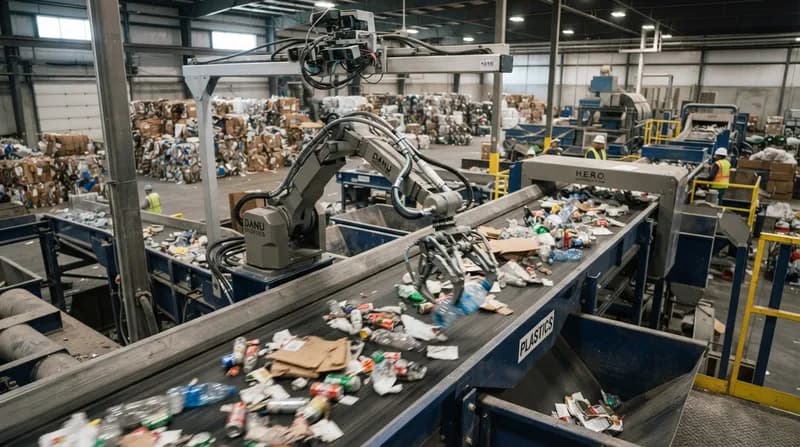
The Challenge of Industrial Recycling
For decades, the promise of a circular economy has been hampered by a single, inefficient reality: humans manually sorting waste. Despite the proliferation of recycling bins in corporate offices and public spaces, far too much material ends up in landfills because current sorting processes are labor-intensive, slow, and expensive. Amy Ma, the founder of Edinburgh-based Danu Robotics, experienced this disconnect firsthand while working in the financial sector, where she witnessed high-end office recycling programs failing due to a lack of backend sorting efficiency.
Ma spent six years refining a robotic alternative that addresses these systemic failures. The resulting solution, H.E.R.O., represents a fundamental shift in how sorting facilities can approach waste streams. By leveraging advanced robotics and continuous software optimization, Danu Robotics is positioning itself to disrupt a global market valued at approximately $20 billion.
The H.E.R.O. System Advantage
What sets H.E.R.O. apart from the current wave of robotic waste-pickers is its mechanical philosophy. While many established competitors rely on vacuum-powered suction systems, the H.E.R.O. unit utilizes a precision pincer claw. This design choice allows for greater versatility in handling varying materials, shapes, and weights, which are often problematic for suction-based systems that may struggle with irregular or dirty waste items. By moving away from complex pneumatics, the system aims to be both more reliable and more durable in the harsh, dusty environments typical of sorting centers.
Beyond the hardware, the company’s core edge lies in its AI-driven software layer. The system is designed for continuous learning, allowing the robot to improve its recognition and sorting accuracy over time. This iterative improvement ensures that the system stays ahead of evolving waste streams, providing facility operators with a tangible ROI. For a typical site, the installation of H.E.R.O. is projected to generate roughly $485,000 in additional annual revenue from recovered materials, far outpacing the initial capital investment and ongoing maintenance fees.
Why it Matters
- Economic Viability: With an initial investment cost of $160,000 and annual maintenance around $24,000, the system offers a clear financial incentive for facilities to replace manual labor with automation.
- Scalability: Danu Robotics has already secured $5 million in late-seed funding and boasts over 200 prospective customers in its sales pipeline.
- Versatility: The long-term roadmap for H.E.R.O. involves miniaturizing the technology. A smaller, portable version of the unit could eventually be deployed at airports, hospitals, and shopping centers to manage waste directly at the source, rather than at centralized sorting plants.
As the company prepares to showcase its technology at TechCrunch Disrupt's Startup Battlefield 200, the industry is watching to see how quickly Danu can scale its manufacturing. By moving sorting technology out of the specialized warehouse and into everyday commercial environments, Ma’s team hopes to fundamentally change how society manages packaging waste and resource recovery.