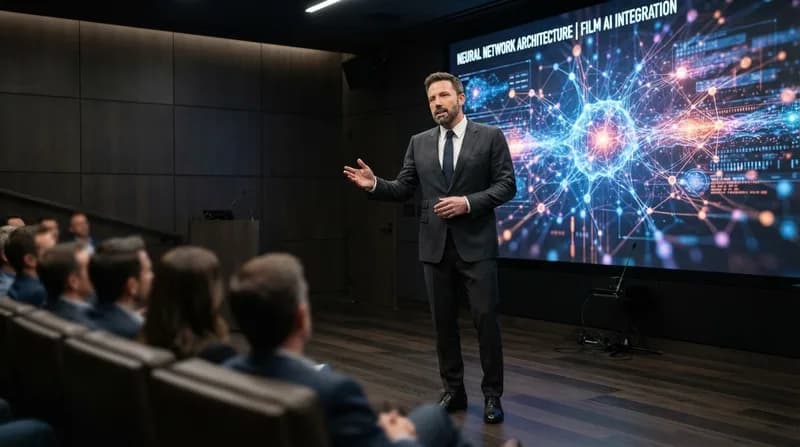
The Unlikely Intersection of Hollywood and Neural Networks
In a turn of events that has caught the tech world off guard, A-list actor and filmmaker Ben Affleck has emerged as a surprisingly fluent expert on artificial intelligence. Recently, during a series of interviews including an appearance on GQ’s "One More Question," Affleck demonstrated a level of technical literacy that goes far beyond surface-level buzzwords. Moving comfortably between discussions of GPUs, tensors, and convolutional neural networks, Affleck provided a masterclass on how AI is fundamentally reshaping the cinematic post-production landscape.
Far from just being a face for a tech endeavor, Affleck has been actively working in the space since founding his venture, InterPositive, in 2022. He frames his journey not as a pivot away from art, but as an evolution of the tools available to creators. By detailing how he employs machine learning to handle complex visual effects—such as automated green screen extraction and precise edge detection—he highlights a pragmatic application of AI that prioritizes creative efficiency over replacing human talent.
Refining the AI Workflow
Affleck’s approach to AI is grounded in the necessity of ethical data sourcing. During his commentary, he emphasized that the "wild west" of model training is insufficient for the high-stakes requirements of professional filmmaking. To address this, he focused on building proprietary datasets through extensive, controlled filming. This allows for late-stage training of open-source models, enabling production teams to maintain ownership over their artistic output while leveraging the sheer computational power of modern neural architectures.
His technical strategy involves unfreezing the weights of existing models and fine-tuning them to meet rigorous cinematic standards. By focusing on specific tasks—such as feature extraction or consistent visual rendering—Affleck’s workflow acts as an additive force for film crews. It allows for the automation of repetitive, time-consuming tasks without compromising the creative vision. For Affleck, the goal is simple: ensure that the technology serves the story and the artists, rather than dictating the narrative structure.
The Philosophy of Responsible AI
Beyond the technical mechanics of Python scripts and tensor translation, Affleck offers a grounded perspective on the broader societal implications of AI. While much of the public conversation remains focused on dystopian "Skynet" scenarios, Affleck shifts the focus toward practical, immediate concerns. He expresses valid apprehension regarding the academic integrity of the next generation, noting the rising prevalence of AI-generated content in higher education and the potential for "learned helplessness."
Why it Matters
- Additive Tech: Affleck’s success demonstrates that AI is best utilized as a specialized tool for complex production workflows rather than a total replacement for human creativity.
- Proprietary Data: The move toward custom-shot datasets highlights a growing industry trend: moving away from generic models toward highly curated, specific, and ethical training environments.
- Accessibility vs. Expertise: His viral status underscores a genuine public appetite for leaders who can bridge the gap between complex engineering concepts and practical, everyday business applications.
Ultimately, Affleck’s commentary serves as a reminder that the most impactful technological advancements often happen at the intersection of disparate fields. By proving that a filmmaker can effectively bridge the gap between creative vision and machine learning engineering, he has sparked a much-needed conversation about how professionals in creative industries can steer the development of AI to preserve both quality and artistic autonomy.