A Potential Window Into New Physics
Researchers at the University of California, San Diego have introduced a novel analytical technique that could finally resolve one of the most persistent mysteries in modern cosmology: whether the universe’s oldest light possesses a hidden, rotational signature. This phenomenon, known as cosmic birefringence, refers to a potential shift in the polarization angle of light originating from the Cosmic Microwave Background (CMB)—the residual radiation left over from roughly 380,000 years after the Big Bang. If proven real, this subtle twist in ancient light could signal physical processes that fall outside the bounds of the Standard Model, potentially providing long-awaited insights into the nature of dark matter and dark energy.
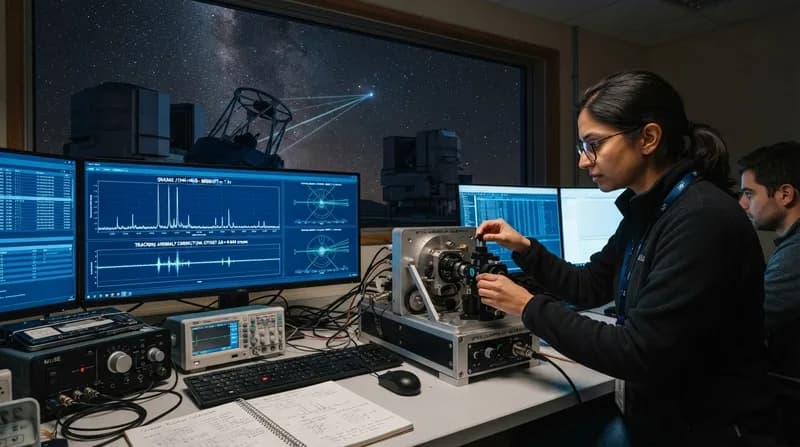
However, the pursuit of this discovery is hampered by a significant technical hurdle. Polarization detectors within advanced telescopes are prone to minute calibration errors. Even a microscopic misalignment in these instruments can create a signal that mimics the appearance of cosmic birefringence, leading scientists to fear they may be observing a mechanical artifact rather than a fundamental cosmic truth. The new methodology developed by the UC San Diego team, led by postdoctoral fellow Anto I. Lonappan and professors Brian Keating and Kam Arnold, provides a rigorous way to filter out these instrumental ghosts.
The Methodology of Separation
The core innovation of the new approach lies in its ability to compare data across different sets of polarization detectors. Rather than relying on a singular, integrated map of the CMB, the researchers analyzed multiple maps generated by distinct groups of sensors. By comparing these maps, the team can isolate and remove rotation signals that are shared across all detectors—a hallmark of systematic instrumental error—while retaining potential cosmic signals that reflect a genuine shift in light polarization across the vastness of space.
To validate this technique, the researchers applied it to existing data from the European Space Agency's Planck satellite. When compared against established analytical frameworks, such as the Minami-Komatsu analysis, the new method yielded consistent results, showing a birefringence angle of approximately 0.37 degrees. While the study confirms that the new framework can reliably mirror existing results, it also serves as a crucial independent verification tool that will be essential for the next generation of observatories, such as the Simons Observatory.
Why It Matters
- Distinguishing Truth from Artifact: The technique provides a critical sanity check for cosmologists, ensuring that future breakthroughs are based on actual astrophysical phenomena rather than sensor misalignment.
- Dark Sector Insights: Confirming cosmic birefringence could provide experimental evidence for hypothetical fields, such as those associated with axion-like particles, helping explain the 95% of the universe composed of dark matter and dark energy.
- Primordial Gravitational Waves: The methodology is highly transferable to the search for primordial B-mode polarization patterns, which are signatures of gravitational waves from the earliest moments of cosmic inflation.
- Strengthening Future Observations: As telescope sensitivity increases, the margin for error shrinks. Rigorous calibration frameworks are the prerequisite for detecting the faint, elusive signals that could rewrite our understanding of the Big Bang.
The Path Toward Primordial Discovery
Looking ahead, the importance of this calibration framework cannot be overstated. Beyond investigating cosmic birefringence, the technique is poised to assist in the hunt for primordial B-mode signals. These distinctive, curl-like patterns in the CMB represent the holy grail of early-universe physics, as they would provide definitive evidence of gravitational waves generated during the inflationary period. Because these signals are incredibly faint, even minor contamination from E-mode signals—caused by instrumental misalignment—could mask or be mistaken for a revolutionary discovery.
As instruments become more sophisticated, the distinction between technological precision and cosmic reality becomes the primary limiting factor for discovery. By offering a robust way to verify data calibration, the UC San Diego team has created a foundation for the next decade of cosmology. Whether this mysterious twist in the ancient light turns out to be a key to dark energy or a fascinating hurdle in detector physics, researchers now have a sharper tool to ensure that when we finally look back to the dawn of time, we see the universe exactly as it is.