A Universal Mechanism for Cosmic Eruptions
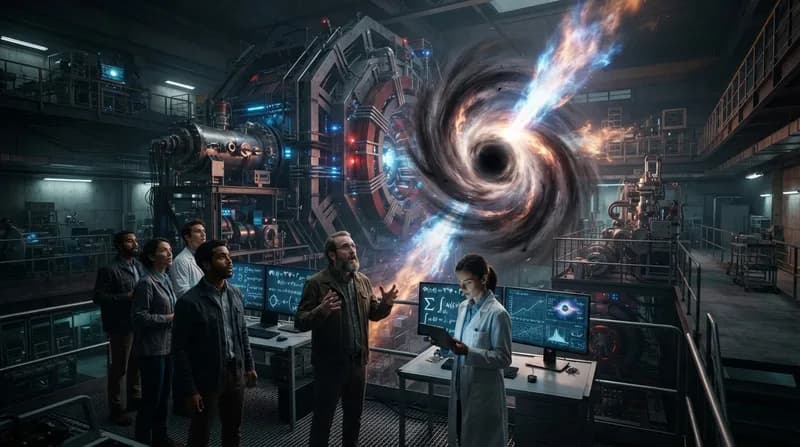
Astronomers have long been captivated by the violent, dramatic nature of black holes—those mysterious gravitational behemoths that occasionally act like cosmic fountains, blasting jets of matter and energy across the universe. While these events have been documented for decades, the triggers behind them remained elusive. A new study, published in Nature Astronomy, has finally cracked the code: black holes, regardless of their mass, adhere to the same universal rule when it comes to launching these spectacular jets.
Led by Dr. Adelle Goodwin of Curtin University and Dr. Andrew Mummery from the Institute for Advanced Study, the research team focused on the feeding cycles of black holes. By synthesizing data from global telescope arrays across diverse wavelengths—including X-ray, radio, and ultraviolet—the researchers identified a specific point in the black hole's consumption process where these eruptions inevitably occur. This discovery shifts our understanding of black holes from unpredictable, erratic actors to entities governed by consistent, underlying physical laws.
The 2% Eddington Rule
The core of this discovery lies in a measurement known as the Eddington limit, a theoretical benchmark that balances the inward pull of gravity against the outward pressure of light. The researchers discovered that when a black hole is in the process of consuming matter—such as the debris from a destroyed star—the jets are typically triggered when the feeding rate drops to exactly 2% of this limit. This threshold holds true whether the black hole is a smaller stellar-mass entity within the Milky Way or a supermassive giant millions of times the size of the Sun.
This "2% rule" explains a long-standing mystery in astrophysics: why some black holes erupt almost immediately after destroying a star, while others remain dormant for months or even years before producing a radio outflow. The delay, researchers found, is simply the time it takes for the black hole's erratic, high-intensity feeding to settle down to that specific, critical 2% mark. It is essentially a predictable "burp" in the cosmic digestion process.
Why This Matters for Future Research
- Optimizing Telescope Resources: Large-scale observatories, such as the upcoming Square Kilometre Array (SKA) in Western Australia, operate on highly competitive, limited observation schedules. By predicting when a black hole will likely erupt, researchers can target these facilities more effectively.
- Validating Fundamental Physics: The fact that this 2% threshold is consistent across such massive scales reinforces the idea that the same fundamental laws of physics govern all black holes, regardless of their size or origin.
- Reducing Data Noise: Knowing when to look for these events allows astronomers to filter out "dead time" in their observations, significantly increasing the success rate of capturing transient cosmic phenomena.
A New Era of Predictive Astronomy
The implications of this study extend well beyond theoretical physics. As we enter a new era of high-precision radio astronomy, the ability to anticipate these eruptions provides a roadmap for the next generation of space exploration. By monitoring the "feeding" activity of black holes during tidal disruption events, astronomers can now pinpoint exactly when these cosmic jets are primed to ignite. This transition from reactive observation to predictive modeling is a significant leap forward in our quest to map the most extreme environments in the universe.
Ultimately, this research serves as a testament to the power of fundamental, curiosity-driven "blue sky" science. What began as a conversation between two scientists in a Madrid bar has transformed into a universal principle, offering a lens through which we can better understand the life cycles of galaxies and the dramatic, energetic outflows that shape them.