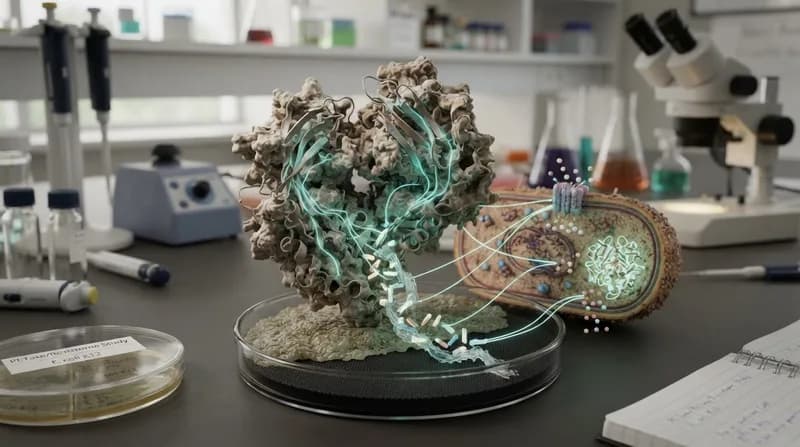
A New Frontier in Biodegradation
Plastic pollution remains one of the most formidable environmental challenges of the modern era. As conventional plastics accumulate in oceans and soil, they persist for centuries, often breaking down into harmful microplastics rather than decomposing into harmless substances. However, a breakthrough study from the University of Konstanz reveals that nature may be evolving a clever solution. Researchers have identified a specialized bacterial enzyme, affectionately dubbed the 'Pac-Man enzyme,' that can effectively digest certain biodegradable polymers, offering a potential blueprint for future waste-management technology.
The study focused on long-chain aliphatic polyesters (LCAP), a class of biodegradable plastics. By observing these materials in forest soil, researchers confirmed that microorganisms are capable of colonizing the plastic surface and breaking down the polymer structure entirely within a period of roughly nine to eleven months—a stark contrast to high-density polyethylene, which remained virtually untouched in the same environment.
The Mechanism Behind the 'Pac-Man' Effect
The name 'Pac-Man' is derived from the enzyme's unique molecular architecture. Through electron microscopy, scientists observed microscopic holes in the plastic films, which matched the precise dimensions of individual bacteria. This suggested that the microbes were not just grazing on the surface, but actively boring into the material.
The team discovered that the bacteria are equipped with plastic-depolymerases anchored directly to their outer cell membranes. This positioning allows the bacteria to remain in constant contact with the plastic substrate while their enzymes dismantle the long molecular chains. The specific enzyme identified features a wide, exposed active site, providing the necessary space to interact with and snap apart polymer bonds, effectively consuming the material to extract carbon and energy.
An Unexpected Evolutionary Twist
Perhaps the most profound aspect of this discovery is the enzyme’s dual functionality. While it is highly efficient at cleaving the ester bonds found in biodegradable plastics, its structural composition also mirrors that of beta-lactamases—a class of enzymes famously responsible for conferring antibiotic resistance in bacteria by deactivating drugs like penicillin.
Laboratory testing confirmed that the 'Pac-Man' enzyme can indeed break down penicillin in a test tube, suggesting that the molecular tools bacteria use to survive in a plastic-rich environment may overlap with the mechanisms they use to defend against medical treatments. This finding presents a significant cautionary note for researchers: as bacteria evolve to exploit new carbon sources like plastic, they may inadvertently sharpen their resistance to antibiotics.
Why It Matters
- Nature's Adaptability: The emergence of these enzymes proves that microbial communities are capable of evolving to process synthetic materials that have existed for less than a century.
- Chemical Design: The research underscores the necessity of designing plastics with specific, microbially-accessible chemical bonds if we are to rely on natural decomposition as a waste-management tool.
- Ecological Risk: The link to antibiotic resistance highlights the need for careful scrutiny when engineering or encouraging the growth of plastic-eating bacteria, ensuring that ecological solutions do not pose public health risks.
As the 'plastisphere' continues to grow as a new habitat for microorganisms, this discovery marks a critical step in understanding how life on Earth is reacting to the human-made surge of synthetic polymers. While the findings provide optimism for the future of plastic degradation, they also serve as a reminder that the environment's response to pollution is complex, multifaceted, and deeply interconnected with other biological imperatives.