E-BUZZ ME Logo
ScienceTechnical Deep Dive

Cancer Cells May Be Breaking Their Own DNA to Keep Growing

Published
Cancer Cells May Be Breaking Their Own DNA to Keep Growing
1 min read97 words

The Gist

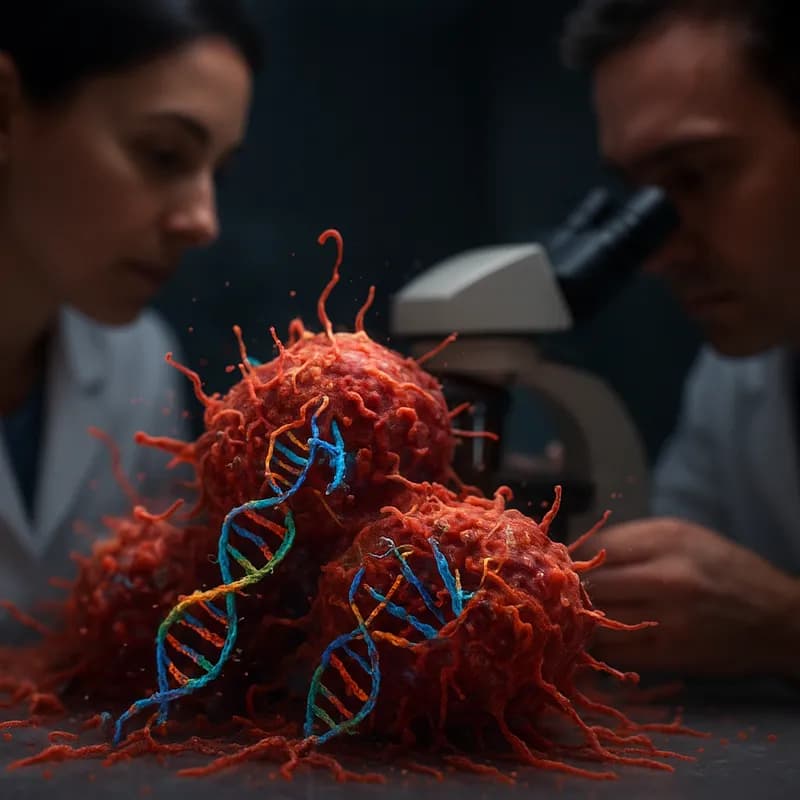
Cancer cells rely on powerful genetic switches to sustain growth, but this intense activity can damage their own DNA, leading to repeated repairs and potential mutations. Researchers believe this self-inflicted damage may aid tumor evolution and create a target for new treatments.

Cancer cells have been found to damage their own DNA as a result of intense genetic activity, which is necessary for their sustained growth. This process, while detrimental to the cell's genetic material, may ultimately contribute to the evolution of tumors.

Key Insights

The self-inflicted damage to DNA in cancer cells leads to repeated repairs, which can result in new mutations. These mutations may play a crucial role in the evolution of tumors, potentially making them more aggressive or resistant to treatments. However, this process also presents a potential target for the development of new cancer therapies.

Related Stories

Semantically matched articles, ranked by topic overlap and freshness.

Stratolaunch Hits New Heights with Talon-A Hypersonic Vehicle
Science

Stratolaunch Hits New Heights with Talon-A Hypersonic Vehicle

Stratolaunch has successfully completed over 10 flights of its Talon-A hypersonic vehicle, marking a significant milestone in its development. The autonomous air-launched craft has the potential for various applications, traveling at five times the speed of sound.

Mathematicians Prove Perfectly Fair Elections Are Impossible
Science

Mathematicians Prove Perfectly Fair Elections Are Impossible

Mathematicians have made a groundbreaking discovery that no electoral system can perfectly balance local representation, proportional national results, and a fixed-size parliament when multiple parties compete. A new voting method has been proposed to mitigate these trade-offs and produce more fair outcomes, offering a potential solution to this longstanding problem.

Eating Less Protein May Slow Aging, Study Finds
Science

Eating Less Protein May Slow Aging, Study Finds

A major review of over 350 studies suggests that consuming less protein can improve metabolism, reduce inflammation, and promote healthier aging. The findings indicate that the current protein boom may be exceeding the actual needs of many individuals, with potential benefits to reducing the signs of aging and increasing lifespan.

Dark Matter's Secret Force Defies Scientific Expectations
Science

Dark Matter's Secret Force Defies Scientific Expectations

Dark matter particles may exert a hidden force on one another, making dark matter effectively lighter as the Universe expands. This force weakens dark matter's gravitational impact and slows the growth of cosmic structure, contrary to initial scientific expectations.

Weekly Brisk Walking Session Found to Trim Belly Fat
Science

Weekly Brisk Walking Session Found to Trim Belly Fat

A recent study reveals that a single 75-minute weekly session of brisk interval walking can effectively reduce body fat and improve cardiovascular fitness, comparable to splitting the exercise across three days. This finding offers a promising approach for adults with central obesity to trim their waistlines and achieve significant health benefits.

Scientists Detect Sharp Acceleration in Global Warming
Science

Scientists Detect Sharp Acceleration in Global Warming

The planet has warmed at a rate of roughly 0.35°C per decade over the past ten years, significantly faster than the 0.2°C per decade rate from 1970 to 2015. This acceleration in global warming is confirmed across five major global temperature datasets with over 98% statistical certainty.

Jefferies Analyst Defends SpaceX Governance
Science

Jefferies Analyst Defends SpaceX Governance

A Jefferies analyst has come to the defense of SpaceX's governance, arguing that investors who blacklist the company due to governance concerns may be overlooking its long-term financial potential. By focusing too much on governance box-checking, these investors risk missing out on significant growth opportunities.

Uncovering the Ancient Human Genome
Science

Uncovering the Ancient Human Genome

Scientists have discovered that modern humans carry fragments of DNA from a long-lost ancient human ancestor, and by reassembling these fragments, they can reconstruct the genome of this mysterious forebear. This breakthrough sheds new light on human evolution and diversity.