The Challenge of Aerial Exploration on Mars
Flying on Mars is an engineering feat that defies conventional terrestrial aviation standards. The Martian atmosphere is exceptionally thin, roughly 1% the density of Earth’s, providing very few air molecules for rotor blades to push against. Consequently, traditional flight dynamics do not apply. While the Ingenuity helicopter made history as the first aircraft to achieve controlled flight on another planet, it was limited by the inherent difficulties of generating lift in such a sparse environment.
To maintain stable flight, Ingenuity’s rotor tips were restricted to a rotational velocity of 2,700 revolutions per minute, keeping them well below the speed of sound. This conservative approach ensured the blades avoided the unpredictable aerodynamic instabilities associated with the sound barrier. However, NASA’s ambition for future missions requires more than just hovering—it requires the ability to carry heavy scientific payloads and navigate complex Martian terrain, necessitating a leap in rotor performance.
Supersonic Testing at the 25-Foot Space Simulator
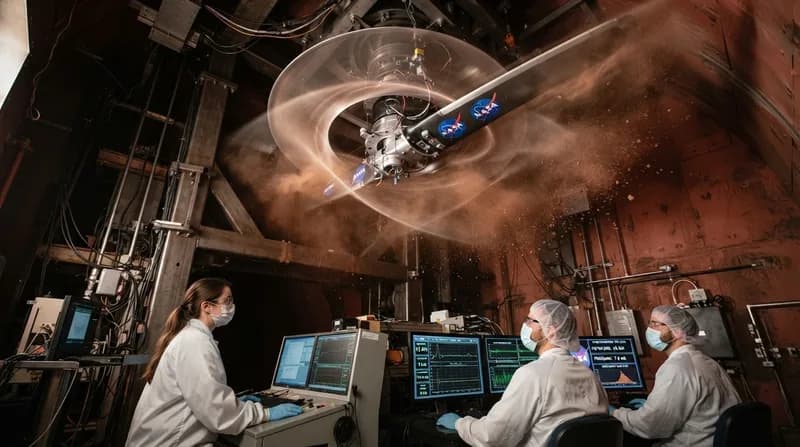
In a series of 137 rigorous test runs at NASA's Jet Propulsion Laboratory, engineers pushed the boundaries of rotor physics. Using the facility's historic 25-Foot Space Simulator, researchers replicated the harsh, cold, carbon-dioxide-rich atmosphere of Mars. The test subjects were high-performance blades developed by AeroVironment, subjected to extreme rotational speeds to determine if they could withstand the transition into the supersonic regime without structural failure.
The testing process was methodical. Researchers began with a three-bladed rotor configuration, spinning it up to 3,750 revolutions per minute. As the tips breached Mach 1.0, the team integrated simulated headwinds to verify the structural integrity of the composite materials under stress. The results were record-breaking: the blades achieved a peak of Mach 1.08, officially shattering the sound barrier under Martian atmospheric conditions.
Why it Matters: The 30% Performance Boost
The successful transition to supersonic tip speeds translates into a 30% increase in total lift capability. This boost is not merely a technical triumph; it is a critical enabler for future Mars exploration. With this extra overhead, next-generation aircraft will be capable of carrying heavier, more sophisticated scientific sensors, batteries, and diagnostic tools, moving beyond the lightweight demonstration profile of Ingenuity.
The implications for mission architecture are profound. By offloading scientific instrumentation to agile aerial platforms, NASA can explore crater floors, steep canyon walls, and other geological formations that are currently inaccessible to traditional wheeled rovers. This increased mobility allows for a much more comprehensive assessment of the planet’s surface and atmosphere.
The SkyFall Project and Future Outlook
Building on these successful results, NASA is actively developing the SkyFall project. This mission concept is currently slated to transport three next-generation helicopters to the Red Planet in December 2028. The SkyFall team has already integrated the data from the supersonic tests into their performance specifications, ensuring these future aircraft are optimized for the thin, cold Martian air.
Beyond the three-bladed test model, engineers also successfully evaluated a two-bladed, longer-span rotor design. This version achieved the necessary speeds at a more efficient 3,570 revolutions per minute, offering an alternative configuration for different payload requirements. With these advancements, NASA is positioning itself to shift from observational flights to active scientific discovery, utilizing the skies of Mars as a primary laboratory for the next decade of exploration.