Revolutionizing Energy at Sea
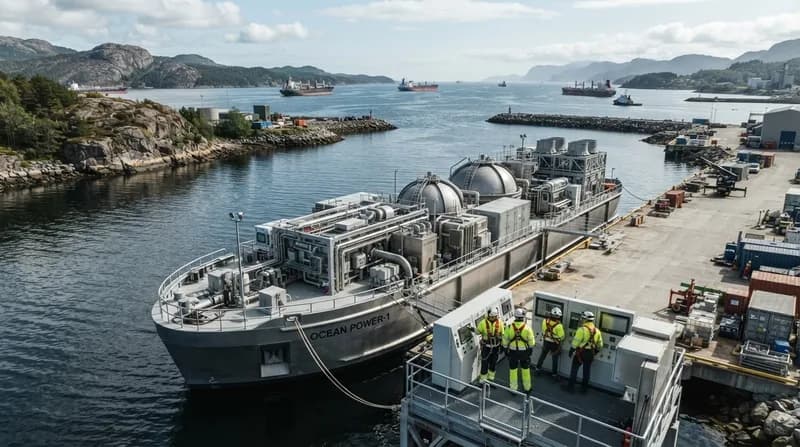
In a bold move to tackle the surging electricity demands of modern infrastructure, Bluecore Energy has successfully raised $50 million in seed funding. This capital infusion, led by Silverton Partners, marks a significant milestone for the California-based startup, which aims to pioneer the deployment of floating, barge-mounted nuclear power plants. Unlike traditional static reactors that require massive terrestrial footprints, Bluecore’s approach relies on modularity and mobility, bringing carbon-free, high-density power directly to the coastlines, ports, and remote settlements that need it most.
The company plans to utilize these funds to advance the engineering and testing phases of its proprietary light-water reactor systems. While the path to commercial operation remains complex, the company has already secured its first barge and is actively developing a non-fueled, electrically heated prototype at its headquarters in the Port of Long Beach. This testing facility is designed to validate the critical monitoring, sensor, and control systems required to keep these maritime reactors safe and efficient during long-term deployment.
Technical Vision and Deployment
Bluecore’s primary design focuses on a compact, 10 MWe output capacity. This scale is intentionally chosen to serve highly specific, energy-intensive clusters, such as AI datacenters or coastal industrial hubs, that are currently constrained by limited grid infrastructure. By anchoring these floating units offshore and utilizing subsea cabling to deliver power, the company effectively bypasses the logistical nightmare of building traditional land-based transmission lines in challenging or isolated environments.
The operational philosophy emphasizes longevity and minimal intervention. Bluecore projects that its reactors can run continuously for years, requiring refueling intervals only every few years. This efficiency, combined with a zero-emission footprint, places the company at the intersection of maritime innovation and the urgent global push for clean energy. The team behind this endeavor is comprised of experts from diverse backgrounds, including veterans from the US Navy’s nuclear submarine program, as well as talent sourced from major industry players like SpaceX, Northrop Grumman, and Rivian.
Why it Matters
- Scalable Infrastructure: By shifting to a modular, barge-based model, Bluecore offers a scalable alternative to the multi-year construction timelines associated with large land-based nuclear plants.
- AI Power Demand: As AI-driven datacenters consume increasing amounts of electricity, these floating reactors provide a localized, consistent, and stable power source that is independent of grid volatility.
- Regulatory Synergy: Bluecore is already in discussions with the US Nuclear Regulatory Commission and the Coast Guard, signaling a collaborative approach to establishing a safety framework for civilian maritime nuclear energy.
The Regulatory and Historical Landscape
While floating nuclear power is a new frontier for commercial civilian use in the United States, the concept of maritime atomic generation is well-proven. The US Navy has decades of experience operating nuclear-powered vessels, dating back to the USS Nautilus in 1955. Bluecore is effectively adapting this deep institutional knowledge for the civilian sector, albeit at a smaller, more specialized scale than the massive aircraft carriers of the US fleet.
The startup must still navigate a challenging regulatory environment, including California’s specific legislative hurdles regarding new nuclear facilities. However, with the backing of the International Atomic Energy Agency’s ATLAS initiative—which encourages the development of maritime nuclear technology—the momentum is clearly shifting toward testing these compact reactors at sea. For now, the industry is watching closely as Bluecore transitions from early-stage design to the rigorous validation of its hardware, marking a potentially transformative shift in how we conceive of mobile, localized power generation.